
Demography and Aging
E N D
Presentation Transcript
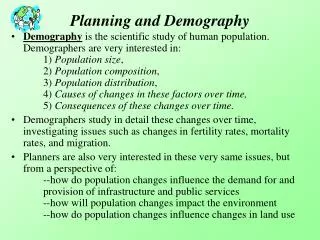
What is “demography”? • Demography is the study of populations • Counting and describing people • Age, sex, income, marital status… • Demographers calculate • life expectancy • birth and fertility rates • average age at marriage…
Three basic processes affect population • Fertility • Mortality • Migration • Many factors affect these processes • Economic development, technology, religious and cultural values…
“Population aging” • 1. How do we measure this?
Indicators of population aging • Greater numbers of older people • Higher median age • A higher percentage of our population is “old” • In 1900, 4% of US population was 65+ • In 1996, just under 13%
2. What was the U.S. “baby boom” and when did it take place? • (and why do we care?!)
3. Which age group in the U.S. population is growing fastest?
What is causing this shift in age? • Increasing life expectancy • =changes in mortality • Declining birth rates • =changes in fertility • 4. Which of these is most important?
Fertility rates, 1950 and 2005 • Africa: 6.7 -> 5.1 • Asia: 5.9 -> 2.5 • Latin American / Caribbean: 5.9 -> 2.6 • North America: 3.5 -> 2.0 • Europe: 2.7 -> 1.4
6. Gender distribution • Are the majority of U.S. older adults men or women? Why?
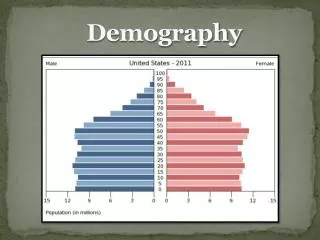
Population pyramids • Also known as “age-sex pyramid” or age structure diagram • Shows how the “shape” of population changes • Often from pyramid (more younger people at the bottom, few old people) to rectangle (more equal distribution between ages)
Want to see more? • http://www.census.gov/ipc/www/idb/informationGateway.php
Uneven geographic distribution • Differences in fertility, mortality, and migration create different population characteristics in different areas • Differences between countries • Differences within countries • Which places in the U.S. are “old”? • Which places are “young”? • What difference does that make??
Interactive census tools… • http://www.census.gov/
Other demographic trends… • Increasing diversity • Increasing levels of education • Changes in families
Changes in families… • …affect who is available to take care of an older person. • Smaller families • Marriages and births at later ages • Increased likelihood of divorce • More blended families • …and the living arrangements of older people.
7. Who helps us when we are old? • Dependency ratios • Old age dependency ratio - % of population 65+ compared to % of population 18 to 64 (the “workers”). • Fewer workers supporting more older people • So old age dependency ratio is INCREASING
Other ratios… • Childhood dependency ratio - % population age 0-17 compared to % population 18 to 64. • This is DECLINING • Overall dependency ratio - STABLE