Comprehensive Guide to Bonds: Features, Ratings, Valuation, and Risk Management
Dive into the essential features of bonds, including contract terms, senior vs. junior claims, and collateral types like debentures. Understand bond ratings and the assessment of creditworthiness, distinguishing investment grade from junk. Explore bond valuation through present value and yield measures, including Yield to Maturity (YTM) and Realized Yield. Learn about convertible bonds, duration, and immunization strategies to manage interest rate risk effectively. Enhance your investment knowledge with detailed insights into bond pricing rules and industry analysis.

Comprehensive Guide to Bonds: Features, Ratings, Valuation, and Risk Management
E N D
Presentation Transcript
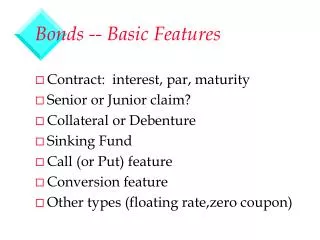
Bonds -- Basic Features • Contract: interest, par, maturity • Senior or Junior claim? • Collateral or Debenture • Sinking Fund • Call (or Put) feature • Conversion feature • Other types (floating rate,zero coupon)
Bond Ratings • Assessment of creditworthiness • Issues rated not firms • Ratings agencies • Investment grade vs. Junk • Ratings changes and value
Bond Ratings -- S&P Outline • Industry Analysis • Industry Risk • Market Position • Operating Efficiency • Management Evaluation • Financial Analysis • Earnings Protection • Financial leverage and asset protection • Cash flow adequacy • Financial flexibility • Accounting Quality
Bond Valuation • Present value! • Assume cash flows known, adjust for risk in the required return (or YTM) • Examples • Bond Pricing Rules • YTM vs. Realized (or Effective) Yield
Yield to Maturity • Interest rate that equates the PV of bond’s future payments with current price • Assumes: • Bond is held to maturity • All coupon and principal payments made in a timely manner • Coupons are reinvested at YTM • YTM is a “promised” yield
Realized Yield • Rate of return actually received on investment at end of holding period • Can be interpreted as expected return if done ex-ante • To find RY: • Find FV of all coupon payments as of end of HP. Use proper reinvestment rate • Add FV to selling price (or par) of bond (TW) • Find compounded rate connecting orig. price with terminal value
Convertible Bonds • “Vanilla” Bond plus option to convert to fixed number of shares of common • Conversion Ratio = # shares per bond • Conversion Price = Par/CR • Conversion Value = Share Price x CR • Conv. Bond Value = Pure Bond Value + Option Value
Duration and Immunization • Price risk and Reinvestment rate risk • Duration is an index of a bond’s price sensitivity to interest rate fluctuations • Can be used to forecast interest rate driven price fluctuations for bonds or portfolios. • ==> Powerful risk management tool! • If Duration = Holding Period, you’re immunized from interest rate risk