Exploration of Ancient Greek Religion, Wars, Rulers, and Cultural Evolution
The ancient Greeks practiced polytheistic paganism, worshipping deities like Zeus, Athena, and Apollo. Their history is marked by significant conflicts, including the Ionian Revolt and the Peloponnesian War. Notable rulers like Philip II and Alexander I shaped their political landscape. The Neolithic Period saw advancements in pottery and animal husbandry, while the Mycenaean Age was characterized by a blend of Minoan and Mycenaean cultures. The Hellenistic Period fostered a flourishing of literature, philosophy, and the arts, significantly influencing future civilizations like the Romans and Christians.


Exploration of Ancient Greek Religion, Wars, Rulers, and Cultural Evolution
E N D
Presentation Transcript
Greeks By: Elexus Spann and Paige Hollingsworth
Their Religion • They practiced Paganism. Since this religion had many gods they were considered polytheistic. • Names of some of their gods and goddess: Aphrodite, Apollo, Athena, Hera, Hermes, Poseidon, Zeus, Dione, Cronus, and Metis.
Greek Wars • Ionian Revolt • First Persian War • Peloponnesian War • Archidamian War • Decelean War
Greek Rulers • Alexander I 496–454 B.C. • Perdikkas II 454–413 B.C. • Archelaos I 413–399 B.C. • Aeropos II 398–395 B.C. • Amyntas II 395–394 B.C. • Amyntas III 393–370 B.C. • Perdiccas III 365–359 B.C. • Philip II 360/59–336 B.C.
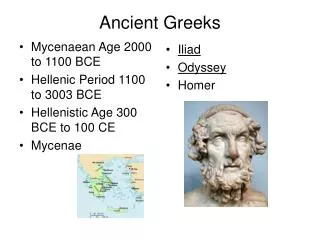
NEOLITHIC PERIOD (6000 - 2900 BC) • They introduced pottery and animal husbandry in Greece. • The economy of the region became steady with organized and methodical farming, stock rearing and, bartering and sculptures like pottery.
MYCENAEAN AGE (600 - 1100 BC) • Mycenae site is located in the Peloponnese, Southern Greece. • The Mycenaeans also inhabited the ruins of Knossos on Crete, which was a major city during the Minoan era. Mycenaean and Minoan art melded, forming a cultural amalgamation that is found on Crete (figurines, sculptures and pottery).
Hellenistic Period (336-146 BC) • During this period Greece produced great literature, poetry, philosophy, drama, and art, the Hellenistic age "Hellenized" the world. • This was a new idea, exporting culture, and more than anything else this exporting of culture would deeply influence all the civilizations and cultures that would later erupt from this soil: the Romans, the Christians, the Jewish Diaspora, and Islam.