Download
1 / 25
250 likes | 353 Vues
This comprehensive overview delves into the fundamentals of light and shading that influence image formation in computer vision. It explores properties of light sources, surface reflectance, and the impact of camera exposure. The relationship between irradiance and radiance is articulated, emphasizing the principles underlying image brightness and surface appearances. Techniques like photometric stereo for reconstructing object shapes from shading cues are discussed. This guide serves as an essential resource for understanding the interactions of light with surfaces and the algorithms used in image processing.

E N D
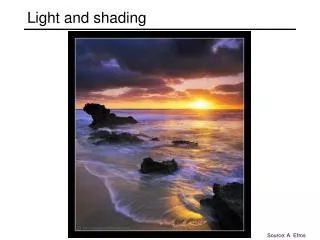
Light and shading Source: A. Efros
Image formation • What determines the brightness of an image pixel? Light sourceproperties Surface shape and orientation Sensor characteristics Exposure Surface reflectanceproperties Optics Slide by L. Fei-Fei
Fundamental radiometric relation • L: Radiance emitted from P toward P’ • E: Irradiance falling on P’ from the lens P α d P’ f z What is the relationship between E and L? Szeliski 2.2.3
Fundamental radiometric relation • Image irradiance is linearly related to scene radiance • Irradiance is proportional to the area of the lens and inversely proportional to the squared distance between the lens and the image plane • The irradiance falls off as the angle between the viewing ray and the optical axis increases P α d P’ f z Szeliski 2.2.3
Fundamental radiometric relation • Application: • S. B. Kang and R. Weiss, Can we calibrate a camera using an image of a flat, textureless Lambertian surface? ECCV 2000.
From light rays to pixel values • Camera response function: the mapping f from irradiance to pixel values • Useful if we want to estimate material properties • Enables us to create high dynamic range images • For more info: P. E. Debevec and J. Malik, Recovering High Dynamic Range Radiance Maps from Photographs,SIGGRAPH 97
The interaction of light and surfaces • What happens when a light ray hits a point on an object? • Some of the light gets absorbed • converted to other forms of energy (e.g., heat) • Some gets transmitted through the object • possibly bent, through “refraction” • Or scattered inside the object (subsurface scattering) • Some gets reflected • possibly in multiple directions at once • Really complicated things can happen • fluorescence • Bidirectional reflectance distribution function (BRDF): how bright a surface appears when viewed from one direction when light falls on it from another Slide by Steve Seitz
Diffuse reflection • Light is reflected equally in all directions • Dull, matte surfaces like chalk or latex paint • Microfacets scatter incoming light randomly • Effect is that light is reflected equally in all directions • Brightness of the surface depends on the incidence of illumination darker brighter
Diffuse reflection: Lambert’s law N S θ B: radiosity (total power leaving the surface per unit area) ρ: albedo (fraction of incident irradiance reflected by the surface) N: unit normal S: source vector (magnitude proportional to intensity of the source)
Specular reflection • Radiation arriving along a source direction leaves along the specular direction (source direction reflected about normal) • Some fraction is absorbed, some reflected • On real surfaces, energy usually goes into a lobe of directions • Phong model: reflected energy falls of with • Lambertian + specular model: sum of diffuse and specular term
Moving the light source Changing the exponent Specular reflection
Photometric stereo (shape from shading) • Can we reconstruct the shape of an object based on shading cues? Luca dellaRobbia,Cantoria, 1438
S2 S1 ??? Photometric stereo • Assume: • A Lambertian object • A local shading model (each point on a surface receives light only from sources visible at that point) • A set of known light source directions • A set of pictures of an object, obtained in exactly the same camera/object configuration but using different sources • Orthographic projection • Goal: reconstruct object shape and albedo Sn F&P 2nd ed., sec. 2.2.4
Surface model: Monge patch F&P 2nd ed., sec. 2.2.4
Image model • Known: source vectors Sjand pixel values Ij(x,y) • Unknown:normal N(x,y) and albedo ρ(x,y) • Assume that the response function of the camera is a linear scaling by a factor of k • Lambert’s law: F&P 2nd ed., sec. 2.2.4
(n × 1) (n × 3) (3× 1) known known unknown Least squares problem • Obtain least-squares solution for g(x,y) (which we defined asN(x,y) (x,y)) • Since N(x,y) is the unit normal, (x,y) is given by the magnitude of g(x,y) • Finally, N(x,y) = g(x,y) / (x,y) • For each pixel, set up a linear system: F&P 2nd ed., sec. 2.2.4
Example Recovered albedo Recovered normal field F&P 2nd ed., sec. 2.2.4
Recall the surface is written as This means the normal has the form: If we write the estimated vector gas Then we obtain values for the partial derivatives of the surface: Recovering a surface from normals F&P 2nd ed., sec. 2.2.4
Integrability: for the surface f to exist, the mixed second partial derivatives must be equal: We can now recover the surface height at any point by integration along some path, e.g. Recovering a surface from normals (for robustness, can take integrals over many different paths and average the results) (in practice, they should at least be similar) F&P 2nd ed., sec. 2.2.4
Surface recovered by integration F&P 2nd ed., sec. 2.2.4
Limitations • Orthographic camera model • Simplistic reflectance and lighting model • No shadows • No interreflections • No missing data • Integration is tricky
Finding the direction of the light source I(x,y) = N(x,y) ·S(x,y) + A Full 3D case: N S For points on the occluding contour: P. Nillius and J.-O. Eklundh, “Automatic estimation of the projected light source direction,” CVPR 2001
Finding the direction of the light source P. Nillius and J.-O. Eklundh, “Automatic estimation of the projected light source direction,” CVPR 2001
Application: Detecting composite photos Real photo Fake photo M. K. Johnson and H. Farid, Exposing Digital Forgeries by Detecting Inconsistencies in Lighting, ACM Multimedia and Security Workshop, 2005.