
Comprehensive Guide to Carpentry Tools & Techniques
E N D
Presentation Transcript
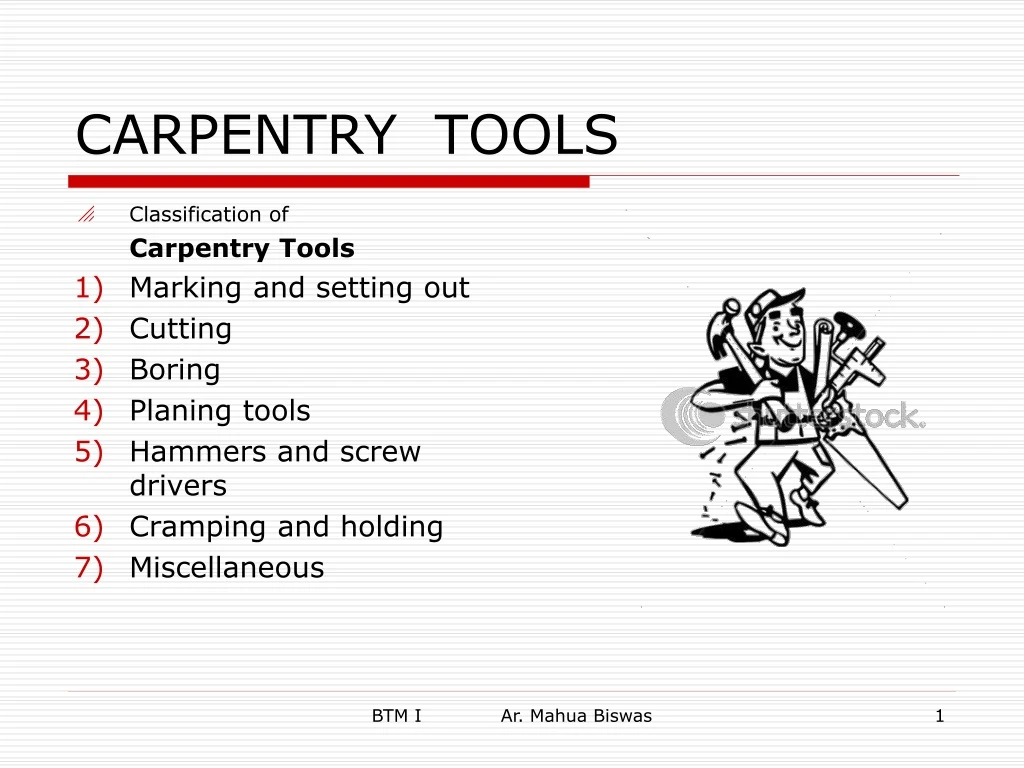
CARPENTRY TOOLS • Classification of Carpentry Tools • Marking and setting out • Cutting • Boring • Planing tools • Hammers and screw drivers • Cramping and holding • Miscellaneous BTM I Ar. Mahua Biswas
CARPENTRY TOOLSMarking and setting out • Marking lines /points on wood • Square :To set right angles • Bevel :To set angles other than a right angles • Marking gauge and mortise gauge: For marking lines parallel to the edges • Marking point and scribing knife:To mark points and lines on wood BTM I Ar. Mahua Biswas
Cutting tools • Tool used for cutting wood - Compass saw • Tools used for cutting timber members are -Coping saw, Cross –cut saw , Dovetail saw • Tools used for cutting and shaping joints are –Tenon Saw, Firmer Chisel, Mortise Chisel, Paring Chisel BTM I Ar. Mahua Biswas
Boring • Used for driving holes in timber members • Rachet brace:-cutting bit is attatched to its lower end and the bit is rotataed with the help of brace handle • Centre Bit, Auger Bit, Rose Counter –Sunk Bit, Screw Drive Bit:Used for boring holes of different size and shapes • Brad Awl ,Pointed Awl:These have sharpened and pointed ends wirth the help of which small and fine holes can be made . • Gimlet:It has screwed end with which small holes can be bored • Auger:Used for deep boring BTM I Ar. Mahua Biswas
Planing tools • Used for Planing surface and for cutting small mouldings along the edges • Bead plane • Jack plane • Rebate plane BTM I Ar. Mahua Biswas
Hammers and screw drivers • Used for driving nails and screws and other fastenings • Claw Hammer, Mallet Hammer, Spall Hammer, Waller’s Hammer. • Screw Driver, Ratchet Screw Driver BTM I Ar. Mahua Biswas
Miscellaneous • Cramp: For clamping timber ,to cut or make groove. • Nail punch: Making small hole before driving nail so that timber does not split on surface • Oil stone: Various tools and blades • Pincers & Pliers: For taking out damaged nails BTM I Ar. Mahua Biswas
Fastenings • Timber joints are secured in position with the help of following commonly used fastenings • Wire nails • Cut nails • Floor brads • Lath nails • Treenail • Pins • Screws • Coach screw • Bolts • Spikes BTM I Ar. Mahua Biswas
Connecters • Dig • Dowels • Sockets • Straps • Wedges • Fasteners BTM I Ar. Mahua Biswas
Fixtures and fastenings • Hinges • Bolts • Handles • Locks BTM I Ar. Mahua Biswas
Hinges • back flap hinge • Butt hinge • Counter flap hinge • Garnet hinge • Nar madi hinge • Parliamnetry hinge • Pin hinge • Rising butt hinge • Strap hinge • Spring hinge BTM I Ar. Mahua Biswas
Latch • Any wood or metal device that is attached to a door or window to keep it closed • The latch consists of plain bar of wood or metal which is attached to door or gate and is pivoted so that it can be raised by hand above a hook or keep attached to door or window frame. • These simple crude devices serve the purpose of keeping the door or window in the closed position BTM I Ar. Mahua Biswas
Handle BTM I Ar. Mahua Biswas
Locks • A lock is any device of wood or metal which is attached to a door or window to keep it closed by the operation of a bolt that moves horizontally into a striking plate or staple fixed to door or window frame • Most locks are made of steel or brass and combine the operation of keeping doors and windows closed with a latch bolt operated by handle or lever and keeping doors and windows securely shut by the operation of a loose key to move a lock bolt BTM I Ar. Mahua Biswas
Rat trap bond • The rat trap bond (RTB) was first introduced by eminent architect Laurie Baker in India and supported by HUDCO. • In the RTB bricks are placed on edge in 1:6 cement mortar as shown in the picture. • With this technique there is reduction in cost of the wall by 25% as with conventional English bond (9’’thk wall) 350 bricks are required per cu. m whereas in Rat-trap bond only 280 bricks are required and also the reduced number of joints reduces the mortar consumption. • No plastering of the outside face is required and the wall usually is quite aesthetically pleasing and the air gaps created within the wall help make the house thermally comfortable. BTM I Ar. Mahua Biswas
Rat trap bond • In summer the temperature inside the house is usually atleast 5 degrees lower that the outside ambient temperature and vice versa in winter. • Thus the main advantages of using Rat trap bond are: • Reduction in cost of the wall by 25%. • The reduction in number of joints, reduces mortar. · 25% less dead weight, 18% savings in bricks and 54% savings in cement mortar • Thermally comfortable & Aesthetically pleasing. BTM I Ar. Mahua Biswas