Download
1 / 8
80 likes | 195 Vues
This overview explains what radiosondes are, the vital atmospheric data they collect, and their significance in meteorology. Radiosondes are instruments carried aloft by weather balloons that measure temperature, dew point, and wind at various altitudes. The data is plotted on a SKEW-T chart, providing a vertical snapshot of atmospheric conditions. Such measurements are crucial for diagnosing the atmosphere, offering insights that help meteorologists predict weather patterns more accurately. By integrating these data with surface reports and satellite observations, we gain a comprehensive view of our atmosphere.

E N D
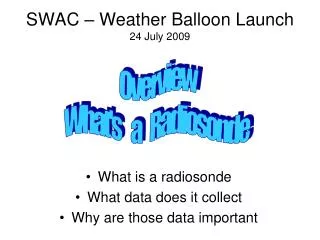
SWAC – Weather Balloon Launch24 July 2009 • What is a radiosonde • What data does it collect • Why are those data important Overview What's a Radiosonde
What is a Radiosonde • balloon carries meteorological instruments aloft (radiosonde) • temperature, dew point (moisture) and wind are measured at various levels • when plotted a snapshot of the distribution of these variables in the vertical results • this plot allows meteorologists to diagnose the atmosphere in the vertical
Plotting the data from a radiosonde on a SKEW-T chart • SKEW-T chart (left) consists of pressure along the “Y” axis or vertical in millibars (MB) • temperature along the “X” axis (Celsius), are solid red lines lower left to upper right. • temperature and dew point values are plotted at junction of appropriate pressure and temperature lines. • for example, the orange dot represents a temperature value of minus 20C at 500 MB pressure level.
What a vertical plot looks like • temperature and dewpoint (moisture) are plotted at appropriate pressure levels • temperature values - RED line • dewpoint temperature values - GREEN line. • the closer together the temperature and dew point, the more moist the air is. • where the lines are close, clouds are likely
Why these measurements are important • These observations allow us to diagnose the atmosphere similar to the snapshot that blood pressure measurements provide • Without these data…we would be limited to observing the atmosphere in one dimension (horizontal) • When coupled with surface weather reports and satellite data, we get a 3 dimensional view (horizontal, vertical and time) of atmospheric temperature, moisture and wind • These measurements provide clues assisting the meteorologist in understanding and anticipating motion in the atmosphere