Download
1 / 8
90 likes | 237 Vues
This lesson explores the concepts of perpendicular lines and angle bisectors. Perpendicular lines intersect at right angles, creating four right angles. We also discuss angle bisectors, which divide angles into two equal parts. Practical exercises include identifying supplementary angles and solving problems involving angle measurements. The connection between perpendicular lines, bisectors, and angle measures is emphasized. By the end of this lesson, students will understand how to find and utilize perpendicular bisectors and complementary angles in geometric problems.

E N D
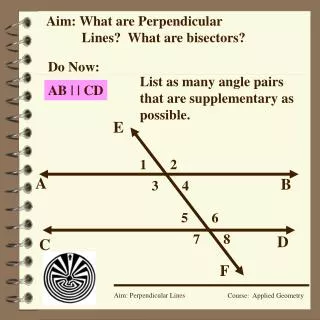
Aim: What are Perpendicular Lines? What are bisectors? Do Now: List as many angle pairs that are supplementary as possible. AB | | CD E 1 2 A B 3 4 5 6 7 8 D C F
l p l p l p 90o 90o 90o 90o Two lines that intersect to form four right angles are perpendicular lines. P e r p e n d i c u l a r L nes
AE EB l AB l E A B Perpendicular bisector P e r p e n d i c u l a r L nes To bisect means to divide into two congruent parts. What is the another name for point E on line AB? Midpoint How many perpendicular bisectors does a line segment have? 1
B C A O What would you call OC? Bisectors What type of angle is BOA? 900 - right angle If mBOC mCOA, what are the measures of the angles? 450 each Angle bisector
Model Problem D A B 3 2 1 O C If m3 = 28, find m 1.
Model Problem D B E A C If mBAC = 160, find m DAE.
3x + 12 If AD AB and AC is the angle bisector of DAB. Find the value of x if the measure of CAB is 3x + 12. C D A B mDAB is 900 since AD is perpendicular to AB mCAB is 450 since AC bisects DAB mCAB = 3x + 12 = 45; x = 11