Download
1 / 10
100 likes | 208 Vues
This overview explores the essential roles of political parties in the electoral process and governance. It covers the organization of political parties, the nomination of candidates, and different party systems, including one-party, two-party, and multi-party dynamics. Historical contexts are provided, focusing on the Federalists and Anti-Federalists, as well as key political transitions in U.S. history. The criticisms and benefits of political parties are discussed to highlight their impact on political participation and public good.

E N D
Political Parties Gov Unit 2
Functions Help electoral process Organize government Nominate candidates
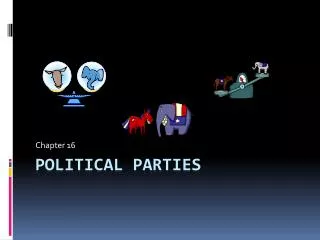
Types of Systems One party Two party Multi -party
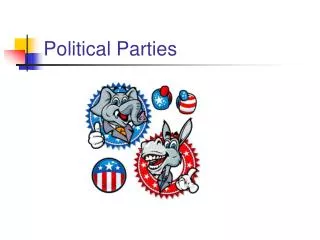
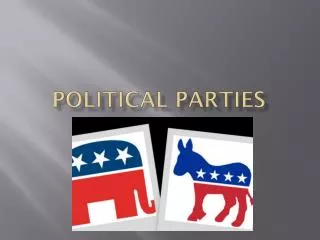
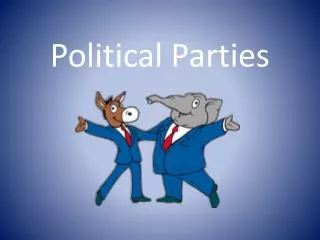
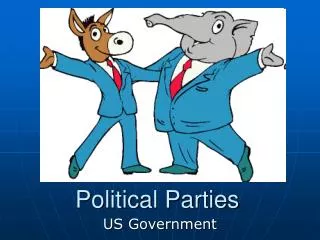
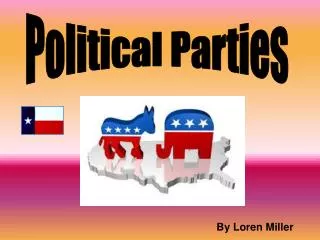
2 Party System http://4.bp.blogspot.com/_6qOBOdiaczY/RxvuCxyH8cI/AAAAAAAAAAk/s_iGLVDJMZI/s320/Elephant%2BDonkey%2BBoxing.jpg
http://www.sar.org/images/presbnnr.jpg Federalist v Anti-Federalists Manufacturing vs farming DR 1800-1829 1st Political Party Federalists v. Democratic Republicans
Democrats v. Whigs Democrats v. Republicans Andrew Jackson drops Republican from name Whigs form to oppose Jackson til 1852 Lincoln elected due to Dem split Republicans hold till 1932 Democrats 32 till 1968 Republicans 68 till ??
http://www.amren.com/ar/2002/10/CoverArtsml.jpg Any party not associated w/ dominant 2 Third Parties- CNN 2004 Candidate not associated w/ any party Third Parties Independents
Party Organization National State Local
Political Parties & Public Good Criticisms • Special Interest • Self-Serving Office Seekers • Politicking • Weakness of Political Parties
Benefits • Provide Information • Accommodate Varied Opinions • Discourage Sudden Shifts • Encourage Political Participation