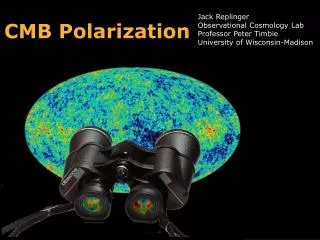
CMB Polarization from Patchy Reionization
This work explores the relationship between CMB polarization and patchy reionization, focusing on how early star formation led to inhomogeneous bubble growth in the cosmic web. The analysis of correlations between CMB polarization and redshifted 21cm radiation provides new cosmological insights. Measurements of quadrupoles at redshift z~10 reveal small signals that are crucial for understanding the optical depth. Despite challenges posed by radio sources and requiring fine-scale measurements, the study suggests that cross-comparison of signals could unveil hidden data about the early universe.


CMB Polarization from Patchy Reionization
E N D
Presentation Transcript
CMB Polarization from Patchy Reionization Gil Holder
Outline • Patchy reionization • CMB polarization • Correlation with redshifted 21cm radiation • Remote quadrupole measurements & Hubble volume 3D reconstruction
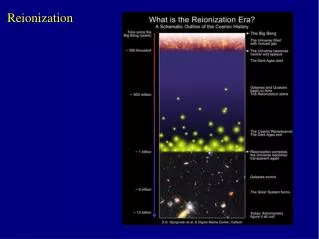
Patchy Reionization • First stars ``blow bubbles’’ in cosmic web • Strongly inhomogeneous • Bubbles growing, becoming more numerous, range in bubble sizes… Furlanetto et al
CMB Polarization quadrupoleanisotropy + Thomson scattering =polarization
Polarization from Patchy Reionization • Very small scales • Very small signal Dore et al
CMB Pol. & Patchy Reionization • Unlikely to be a problem for inflation B modes • Mainly confined to single Stokes component Dore et al
Thomson optical depth/21cm anti-correlation Thomson optical depth 21 cm emission Mass density (slice dz~1; 100 Mpc on a side) Holder, Iliev & Mellema
Some equations… 21 cm fluctuations Optical depth Optical depth fluctuations 21 cm - (optical depth) anti-correlation
Thomson optical depth/21cm anti-correlation Early times: blowing bubbles (ionize and awe) Late times: last throes of neutral overdense regions Holder, Iliev & Mellema
The benefits of alien collaborators at z~10 • Surface of last scattering at z=10 has little overlap with ours • More than 1/2 of signal from “dark ages” • Good enough data over large patch of sky allows reconstruction of “initial conditions” for most of Hubble volume • Needs polarized 0.1 uK on arcminute scales and mK redshifted 21 cm
Comparison with Galaxy Clusters • Z~9 : mean density x1000, comoving 10 Mpc=1 Mpc • At z=0, this is a galaxy cluster! • Remote quadrupoles with galaxy clusters suggested by Kamionkowski & Loeb • Z=10 has less overlap with z=0 CMB • Optical depth from 21cm instead of ??? • No galaxy cluster in the field (radio halos, AGN, CMB lensing) SZ Image by Laurie Shaw
How hard is this? • Need 100 nK in CMB polarization on arcminutes scales (basically 100 times the collecting area of APEX) • Need few mK at wavelengths of few m (likely needs SKA) • Radio point sources will be particularly nasty • Big bubbles around largest sources could have 10x larger signal and detectable with current technology
Summary • Fine-scale polarization measurements allow new cosmological insights • Redshifted 21cm emission well anti-correlated with CMB polarization • Cross-comparison allows measurement of quadrupoles at z~10 (but signals are small) • 21cm gives you optical depth • CMB polarization=optical depth * quadrupole • mK radio signal and 100 nK CMB pol on 1’ scales