Andrew Jackson: Champion of the People and Controversy in Early American Politics
This chapter explores Andrew Jackson's presidency (1829-1837) as a pivotal era in American history. Known as a "man of the people," Jackson's leadership marked the rise of populism and the expansion of democracy. Key themes include his use of patronage through the spoils system, his controversial veto powers, and the Tariff Act of 1828, termed the "Tariff of Abominations." The chapter also addresses tensions surrounding states' rights, Indian removal policies including the Trail of Tears, and conflicts such as the Black Hawk War. Jackson's legacy influenced subsequent political developments in the U.S.

Andrew Jackson: Champion of the People and Controversy in Early American Politics
E N D
Presentation Transcript
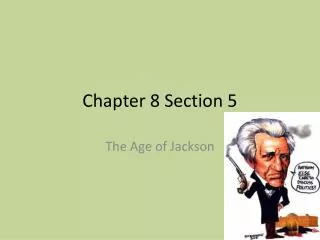
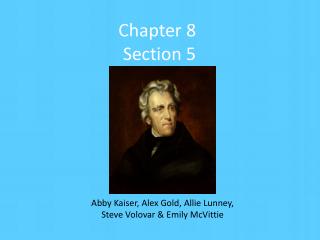
Chapter 8 Section 5 March 1829- Andrew Jackson- president “Man of the people”
Chapter 8 Section 5 • Power- west- growing • 1st president- west of the Appalachians • Patronage- government jobs to supporters • Spoils system • Veto power to restrict federal activity • Tariff Act of 1828- tax on imports • Why? Boost US manufacturing • “Tariff of Abominations”
Chapter 8 Section 5 • SC- nullify- reject • States’ rights- not federal government nor denies the states • Secede- withdraw • Daniel Webster- senator- MA • Defended the Union • Robert Hayne- SC senator • States’ rights • 1833- Congress- Force Bill- SC- difficult to block the tariff
Chapter 8 Section 5 • Indian relocation- “Five Civilized Tribes” • Indian Removal Act • Native Americans- land- Louisiana Purchase • Cherokees- white farming methods • Worcester v. Georgia • GA- no authority over Cherokee land • 1838- Trail of Tears • 25%- Cherokees die
Chapter 8 Section 5 • Black Hawk War • Retreated in WS territory • Second Seminole War • Osceola- captured • Bank War- vetoed to recharter the bank • Martin Van Buren- president • Panic of 1837 • William Henry Harrison- president • Died of pneumonia • John Tyler now the president