Understanding Image Formation in Optics: From Blur Circles to Specular Surfaces
Learn about image formation concepts in optics, including blur circles, irradiance, radiance, solid angles, Lambertian and specular surfaces, Phong's model, and human eye optics.


Understanding Image Formation in Optics: From Blur Circles to Specular Surfaces
E N D
Presentation Transcript
Blur circle Points a t distance are brought into focus at distance is imaged at point A point at distance from the lens and so Thus points at distance will give rise to a blur circle of diameter with d the diameter of the lens
Irradiance, E • Light power per unit area (watts per square meter) incident on a surface. • If surface tilts away from light, same amount of light strikes bigger surface (less irradiance)(no foreshortening) • E timespixel area times exposure time -> pixel intensity light surface
Radiance, L • Amount of light radiated from a surface into a given solid angle per unit area (watts per square meter per steradian). • Note: the area is the foreshortened area, as seen from the direction that the light is being emitted. • Brightness corresponds roughly to radiance light surface
Solid angle • The solid angle subtended by a cone of rays is the area of a unit sphere (centered at the cone origin) intersected by the cone • A hemisphere cover 2p sterradians
Radiosity The total power leaving a point on a surface per unit area on the surface If radiance independent of angle -> ingegrate over hemisphere
BRDF unit:
Special Cases: Lambertian Note: reflected light is with strength proportional to cos of angle with surface normal, but the area is foreshortened • Albedo is fraction of light reflected. • Diffuse objects (cloth, matte paint). • Brightness doesn’t depend on viewpoint. • Does depend on angle between light and surface. Surface normal Light q
Lambertian Examples Lambertian sphere as the light moves. (Steve Seitz) Scene (Oren and Nayar)
Specular surfaces • Another important class of surfaces is specular, or mirror-like. • radiation arriving along a direction leaves along the specular direction • reflect about normal • some fraction is absorbed, some reflected • on real surfaces, energy usually goes into a lobe of directions (http://graphics.cs.ucdavis.edu/GraphicsNotes/Shading/Shading.html)
Specular surfaces • Brightness depends on viewing direction. (http://graphics.cs.ucdavis.edu/GraphicsNotes/Shading/Shading.html)
Phong’s model • Vision algorithms rarely depend on the exact shape of the specular lobe. • Typically: • very, very small --- mirror • small -- blurry mirror • bigger -- see only light sources as “specularities” • very big -- faint specularities • Phong’s model • reflected energy falls off with (Forsyth & Ponce)
Lambertian + specular • Two parameters: how shiny, what kind of shiny. • Advantages • easy to manipulate • very often quite close true • Disadvantages • some surfaces are not • e.g. underside of CD’s, feathers of many birds, blue spots on many marine crustaceans and fish, most rough surfaces, oil films (skin!), wet surfaces • Generally, very little advantage in modelling behaviour of light at a surface in more detail -- it is quite difficult to understand behaviour of L+S surfaces (but in graphics???)
Lambertian+Specular+Ambient (http://graphics.cs.ucdavis.edu/GraphicsNotes/Shading/Shading.html)
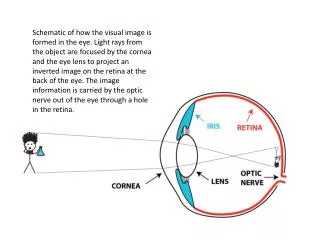
Human Eye • pupil: 1-8mm • Refracting power (1/f) 60-68 diopters (1 diopter = 1m-1) • Macula lutea: region at center of retina • Blind spot: where ganglion cell axons exit retina from the optiv nerve http://www.cas.vanderbilt.edu/bsci111b/eye/human-eye.jpg