Understanding Central Angles and Arc Measurements in Circles
This lesson covers central angles and arc measurements within circles, focusing on concepts such as finding the measures of various angles and arcs, understanding adjacent arcs, and using graphs to interpret data related to circle geometry. Students will engage with problems that involve calculating percentages and determining relationships between different parts of circles. The lesson reinforces the definitions of minor and major arcs, as well as congruent arcs, while providing opportunities for practical application through quizzes and example problems.

Understanding Central Angles and Arc Measurements in Circles
E N D
Presentation Transcript
Central Angles 9.2a
Warm Up 1.What percent of 60 is 18? 2. What number is 44% of 6? 3. Find mWVX.
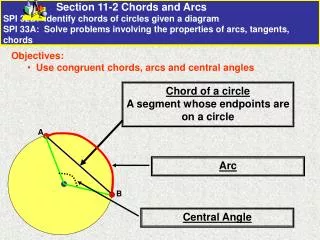
A central angleis an angle whose vertex is the center of a circle. An arcis an unbroken part of a circle consisting of two points called the endpoints and all the points on the circle between them.
Writing Math Minor arcs may be named by two points. Major arcs and semicircles must be named by three points.
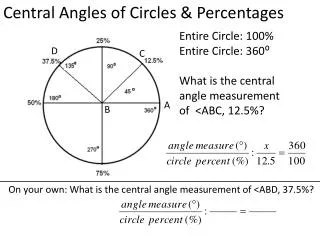
The circle graph shows the types of grass planted in the yards of one neighborhood. Find mKLF.
b.mAHB Use the graph to find each of the following. a.mFMC c.mEMD
Adjacent arcs are arcs of the same circle that intersect at exactly one point. RS and ST are adjacent arcs.
mJKL Find each measure.
mLJN Find each measure.
Within a circle or congruent circles, congruent arcs are two arcs that have the same measure. In the figure STUV.
Find each measure. A B, and CD EF. Find mCD.
Lesson Quiz: Part I 1. The circle graph shows the types of cuisine available in a city. Find mTRQ.
Lesson Quiz: Part II Find each measure. 2. NGH 3. HL
Lesson Quiz: Part III 4. T U, and AC = 47.2. Find PL to the nearest tenth.