Innovative Electronic Dartboard for Automatic Scoring and Enhanced Gameplay Experience
This project presents the development of an Electronic Dartboard (ED) designed to automatically keep track of scores, enhancing the recreational activity for various users. The ED features an advanced sensing array and software for efficient data transmission and computation, ensuring accurate and reliable scoring. Unlike conventional dartboards, which are often unreliable and unattractive, this product combines sleek design with robust technology to minimize disputes over scoring and allow players to focus on the enjoyment of the game.

Innovative Electronic Dartboard for Automatic Scoring and Enhanced Gameplay Experience
E N D
Presentation Transcript
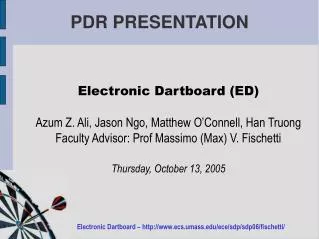
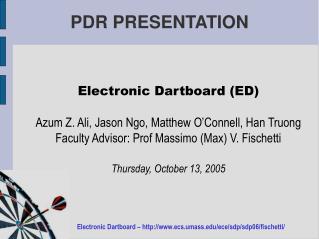
Electronic Dartboard (ED) Azum Z. Ali, Jason Ngo, Matthew O’Connell, Han Truong Faculty Advisor: Prof Massimo (Max) V. Fischetti Thursday, October 13, 2005 PDR PRESENTATION
Introduction • Building an Electronic Dartboard (“ED”) that automatically keeps track of score • Recreational activity for a variety of potential customers • Automation is provided by electronic system • Sensing Array • Intermediate hardware for data transmission • Software for computation and output
ED's Design horse hair/cork reliable scoring sleek design regulation size any standard darts Background • Dartboard on the market • made out of plastic • very unreliable • unattractive • not regulation • use plastic darts
Motivation • Darts are a fun recreational activity • Project deliverable fun and enjoyable • End disputes over scoring, cheating • No longer responsible for scorekeeping, more focus on fun and gameplay • Great to demo for SDP06
Overview • Sectionalized board • Sensing electronics • Data Transmission • Software • Combine into functional design
Long-term goal • MDR • Working reliable sense system • Efficient data transmission • Final Design • All sections working • Accurate scoring
The Present Situation • Researched hardware specs • All sensors are on order (multiple options) • Micro-controllers chosen • Chose serial transmission • Overall plan agreed upon
Development up to present • Members researched different sensors • Spare dartboard for implementation • Extra parts for testing • Sensors agreed to test • Strain gauges, Piezoelectric, Push-Button • Sensor rejected • Laser grid (cost, unfeasible implementation)
Potential Alternatives • Strain gauges • pressure applied resistance goes up • create resistor circuit for voltage differences • Pros • Simple design • Sensitive to pressure • Low cost • Cons • Is it too sensitive?
Potential Alternatives(contd.) • Piezoelectric • Disturbance in Quartz crystals on Piezo material induces a voltage • Pros • Low cost • Piezo material can cover area needed • Good sensitivity • Cons • Could damage Piezo film with darts
Potential Alternatives(contd.) • Pushbutton • Spring is compressed, voltage signal output • Pros • reliable • different sizes, shapes, springs • Low cost • Cons • sensitivity of pressure applied • spring constants
Dartboard Electronics • Pressure sensors • A/D Converter • Foot Line Sensor • Power supply
Microprocessor • Receive Data • Store Data • Convert Data • Transmit Data • Serial Connection
Computer Program • Store Data • Compute Data • Display Data • GUI
Proposed MDR Specifications • One or more sensing options working • Operational sensor applied to sections on dartboard • Serial transmission of bits to computer • Computer recognizes values assigned to sections
Conclusion • Automatically keep score • Efficient and Reliable Sensing • Values recognized and Displayed on GUI • Overall fun and hassle-free gameplay!