Download
1 / 14
140 likes | 262 Vues
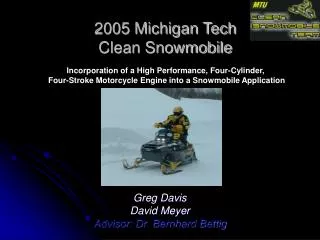
The MTU Clean Snowmobile project aims to design a clean, quiet, and high-performance snowmobile suitable for various enthusiasts. Led by Matt Prusak and Wes Barrett, the project emphasizes significant improvements over current snowmobile technology, focusing on reduced noise and emissions while maintaining high performance. With features like a four-stroke Honda engine, advanced exhaust systems, and a durable chassis built for all users, this innovative snowmobile tackles environmental concerns without sacrificing the joy of riding. The project promises lower operating costs, high resale value, and reliability for dealers and consumers alike.

E N D
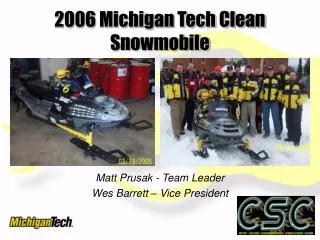
2006 Michigan Tech Clean Snowmobile Matt Prusak - Team Leader Wes Barrett – Vice President
Concept “Design and build a clean, quiet, reliable, high-performance snowmobile that is enjoyable to ride in a wide variety of conditions, and can be operated by a wide range of enthusiasts.”
Outline • Why is the MTU Clean Snowmobile superior to current technology? • Consumer Perspective • High-Performance • Environmental Perspective • Low Noise • Low Emissions • Dealer/Outfitter Perspective • Durable • Low Cost • High Resale Value
Performance - EngineConsumer Perspective • ’03 Honda CBR 954RR • 4-cycle • 4-cylinder • 4 valves per cylinder • Electronic Fuel Injection • 113kW (152 rwhp) in OEM trim
Performance – ChassisConsumer Perspective • Premium suspension components • Fox Float front shocks used • Highly tunable • Rear suspension spring and damping rates modified • Extensive on-trail Calibration • Multiple-rider input for 200 miles • Calibrated for best possible compromise between bump absorption, and weight transfer for a wide range of users, from beginner to expert
Emissions DevelopmentEnvironmental Perspective • Why use a four-stroke engine? • The numbers don’t lie
Emissions Strategy • Team-Designed Exhaust System • Emitec Catalytic Converter Installed • Power Commander Piggyback EFI Modifier • Used to Modify OEM Fuel Map • Significant reductions in tailpipe emissions compared to OEM engine calibration • 96.6% Average Reduction in HC • 97.2% Average Reduction in CO • 93.1% Average Reduction in NOx • Stoichiometric Operating Conditions
Noise ReductionEnvironmental Perspective How? • Team designed Helical Gearbox • Intake silencer • 2 piece muffling system • Primary Supercritical muffler • Secondary glass pack to absorb high frequency noise • Closed off hood vents • Sound absorbing material in belly-pan • Minimized idler wheels in rear suspension • Made Use of Arctic Cat style Quiet Track Technology
Secondary Muffler Testing Noise Reduction TestingEnvironmental Perspective Selections: • Long Red GP – 83.1 dBA • Good combination of noise and power output
J-192 Field Testing Noise Reduction TestingEnvironmental Perspective Selections from testing: • Covered Silenced Intake – 74.5 dBA • Closed Hood Vents – 73.5 dBA
DurabilityDealer/Outfitter Perspective • Built on a Polaris Pro-X race driven Chassis • Torture tested for over 200 miles on ungroomed trails • Powered by a race proven Honda 954cc High Performance street bike engine • Dyno Tested for over 100 hrs • Constant 10 minute intervals at mode 1 calibration point
Cost AnalysisDealer/Outfitter Perspective • 2006 TICA • Total Implementation Cost Analysis (TICA) of $1346.19 • Coming in at around $9400.00 makes it cheaper than the new 4-strokes when added to price of Stock 600 Polaris • Highly tuned 4-stroke Engine • Consumes Less fuel than stock – Approx. 14 mpg • Maintenance Free • Fouling spark plugs isn’t even considered • Uses no oil, changing oil/filter seasonally