Download
1 / 19
190 likes | 301 Vues
This lesson focuses on the Triangle Sum Theorem and the Parallel Postulate. Students will learn to identify and apply these fundamental geometric concepts, including how the angles of a triangle sum to 180 degrees and the conditions for parallel lines. Through warm-up activities, students will engage in problem-solving exercises that incorporate algebraic scenarios and review the Zero Product Property. The lesson enhances understanding through diagrams and examples, guiding students in finding unknown angle measures and applying geometric reasoning.

E N D
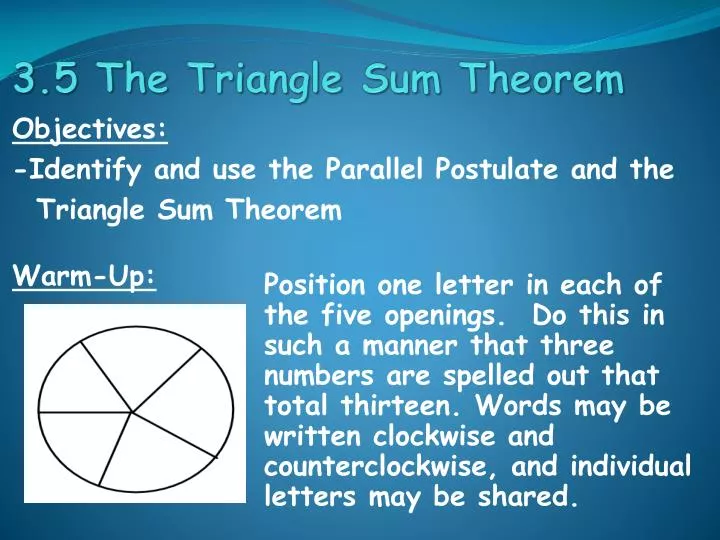
3.5 The Triangle Sum Theorem Objectives: -Identify and use the Parallel Postulate and the Triangle Sum Theorem Warm-Up: Position one letter in each of the five openings. Do this in such a manner that three numbers are spelled out that total thirteen. Words may be written clockwise and counterclockwise, and individual letters may be shared.
The Parallel Postulate: Given a line and a point not on the line, there is one and only one line that contains the given point and is parallel to the given line.
The Triangle Sum Theorem: The sum of the measures of the angles of a triangle is
Exterior Angle Theorem: The measure of the exterior angles of a triangle are equal to
Example: Two angle measures are given. Find the missing angle measure or state that the triangle does not exist. m<A=, m<C= m<1=, m<3= m<K_, m<M= m<X=, m<Z=
Example: Refer to the diagram below, in which DF||BC, AB||FC, m<ADE=, & m<ACB= m<BDE= A m<DBC= m<CEF= E F D m<AED= m<DEC= B C m<DAE= m<ECF=
Example: Find the indicated angle measure. 3 2 1
Example: Find x and the measure of each angle. x = A m<A= m<B= B C m<C=
Example: Find x and the measure of each angle. x = A m<A= m<B= B C m<C=
Example: Find x and the measure of each angle. x = A m<A= m<B= B C m<C=
Example: Refer to the diagram below to complete the table. 2 3 1 4
3.5 The Triangle Sum Theorem Cont’d Objectives: -Identify and use Triangle Sum Theorem with algebraic scenarios that require factoring. Warm-Up: Travel through this maze totaling exactly 100 points. No passage or intersection may be used more than once. Enter and exit the maze at the designated arrows.
Example: Find x and the measure of each angle. m<Y= x = m<W= m<Z= W Y Z
Example: Find x and the measure of each angle. m<B= x = m<A= m<C= A B C
Example: Find x and the measure of each angle. m<E= x = m<D= m<F= D E F
Example: Find x and the measure of each angle. m<B= x = m<A= m<C= A B C
Example: Find x and the measure of each angle. m<E= x = m<D= m<F= D E F