Comprehensive Mission Design for a Next-Generation Space Telescope
This document outlines a proposed mission for a next-generation space telescope, detailing the scientific objectives, system requirements, and associated challenges. It defines the telescope's specifications, including wavelength range, size, sensitivity, and resolution. The orbit selection balances data rate and background noise, while calculations address data volume and downlink requirements. A suitable spacecraft bus and launch vehicle are identified to support the mission. Major risks are assessed, and a total mission cost estimate is provided for transparency and planning.

Comprehensive Mission Design for a Next-Generation Space Telescope
E N D
Presentation Transcript
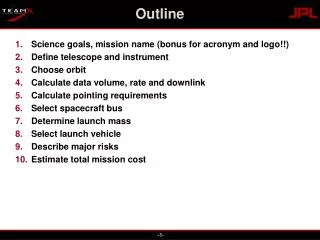
Outline • Science goals, mission name (bonus for acronym and logo!!) • Define telescope and instrument • Choose orbit • Calculate data volume, rate and downlink • Calculate pointing requirements • Select spacecraft bus • Determine launch mass • Select launch vehicle • Describe major risks • Estimate total mission cost
1. Science goals • Major science goals and relevance to field • Mission name (and acronym/logo)
2. Define telescope and instrument • Wavelength • Size • Sensitivity • Resolution (spectral and angular) • Thermal Requirements • Duration
3. Choose orbit • Consider data rate, background noise, launch cost
4. Calculate data volume and rate • Calculate data volume and rate • Is this consistent with orbit and downlink capabilities?
5. Calculate pointing requirements • Use the least stringent pointing needed to accomplish the science
6. Select spacecraft bus • Depends on size of instrument, telecom capability, pointing capability
7. Determine launch mass • Telescope • Bus • Instrument • Propellant • Margin
8. Select launch vehicle • Mass • Orbit • Cost
9. Describe major risks • Unusual size • New technologies • Below guideline margins
10. Estimate total mission cost • Telescope • Bus • Instrument • Launch vehicle • Operations • Reserves