The Element Carbon: Foundation of Biological Molecules in Biochemistry
Carbon is a fundamental component of nearly all biological molecules, possessing four electrons in its outermost energy level, allowing for diverse bonding structures, including straight chains, branched chains, and rings. These characteristics enable the formation of functional groups that greatly influence molecular properties. Key biomolecules, including carbohydrates, proteins, lipids, and nucleic acids, are essential for life, each with unique structures and functions. Understanding these macromolecules and their interactions is crucial in biochemistry and biology.

The Element Carbon: Foundation of Biological Molecules in Biochemistry
E N D
Presentation Transcript
Biochemistry Chapter 3
The element carbon is a component of almost all biological (organic) molecules.
Carbon has 4 electrons in its outermost energy level. • Carbon compounds can be straight chains, branched chains, and rings.
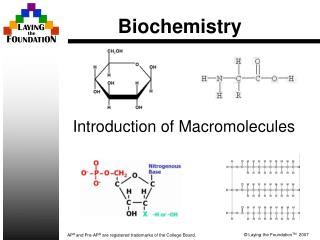
Carbon can share 1, 2, or 3 pairs of electrons with another atom • Functional groups influence molecule characteristics Hydroxyl –OH O Carboxyl –C-OH H Amino N-H O Phosphate -O-P-OH OH
Macromolecules large molecules formed by joining smaller organic molecules • Polymersmolecules made from repeating units of identical or nearly identical compounds linked together by covalent bonds
Condensation Reaction-water is released each time a monomer is added to a polymer • Hydrolysis-water breaks down a polymer • Reverse of each other
Energy Currency • adenosine triphosphate-ATP • Bonds between the phosphate groups are less stable • When bond is broken, (hydrolysis) energy is released
Carbohydrates • Compounds composed of carbon, hydrogen, and oxygen in a ratio of one oxygen and two hydrogen atoms for each carbon atom—(CH2O)n
Values of n ranging from three to seven are called simple sugars, or monosaccharides. • Two monosaccharides joined together form a disaccharide. • Longer carbohydrate molecules are called polysaccharides.
Proteins • A compound made of small carbon compounds called amino acids
Amino acids have a central carbon atom. • One of the four carbon bonds is with hydrogen. • The other three bonds are with an amino group (–NH2), a carboxyl group (–COOH), and a variable group (–R).
The number and the order in which the amino acids are joined define the protein’s primary structure. • After an amino acid chain is formed, it folds into a unique three-dimensional shape, which is the protein’s secondary structure, such as a helix or a pleat.
Lipids • Molecules made mostly of carbon and hydrogen • A triglyceride is a fat if it is solid at room temperature and an oil if it is liquid at room temperature. • Lipids only single bonds - saturated fats. • Lipids at least one double bond - unsaturated fats. • Fats more than one double bond - polyunsaturated fats.
Phospholipids • Made of a glycerol, phosphate group and 2 fatty acid chains • 2 layers of these-bilayer-makes up cell membranes
Nucleic acids - complex macromolecules that store and transmit genetic information-DNA, RNA • Nucleic acids are made of smaller repeating subunits called nucleotides, made of carbon, nitrogen, oxygen, phosphorus, and hydrogen