Understanding Data Transmission: Packets, Error Checking, and Protocols
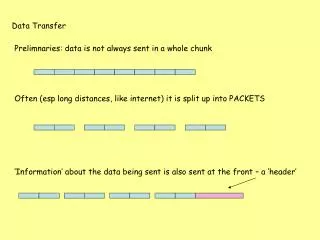
Data transfer is often segmented into packets, particularly over long distances like the internet. Each packet contains a header with information about the data being sent. Error-checking methods ensure data integrity during transmission; for instance, if discrepancies arise, packets are retransmitted. Techniques such as checksums and parity bits help verify data correctness. Additionally, protocols define the format and rules for data transmission, including error correction methods, packet size, compression algorithms, and end-of-transmission indicators. Understanding these elements is crucial for efficient data communication.

Understanding Data Transmission: Packets, Error Checking, and Protocols
E N D
Presentation Transcript
Data Transfer Prelimnaries: data is not always sent in a whole chunk Often (esp long distances, like internet) it is split up into PACKETS ‘Information’ about the data being sent is also sent at the front – a ‘header’
Error checking methods When data is sent, checks are made on it. If the check doesn’t match up for a packet, it is re-transmitted e.g. Checksum Total = 551 551 23 14 121 56 11 5 103 72 34 112 Total = 557 551 23 14 121 56 14 8 103 72 34 112 e.g. Parity bits a 0 or a 1 to make the no of 1’s even (even parity) or odd (odd parity) 10110101110101100 1 . parity bit
Protocol • This is an agreed format in which the data will be transmitted. • It will in clude aspects such as • what error correction method is used • how many byte per packet • what compression algorithm is used • what bit pattern will indicate the end of transmission • lots of other stuff!