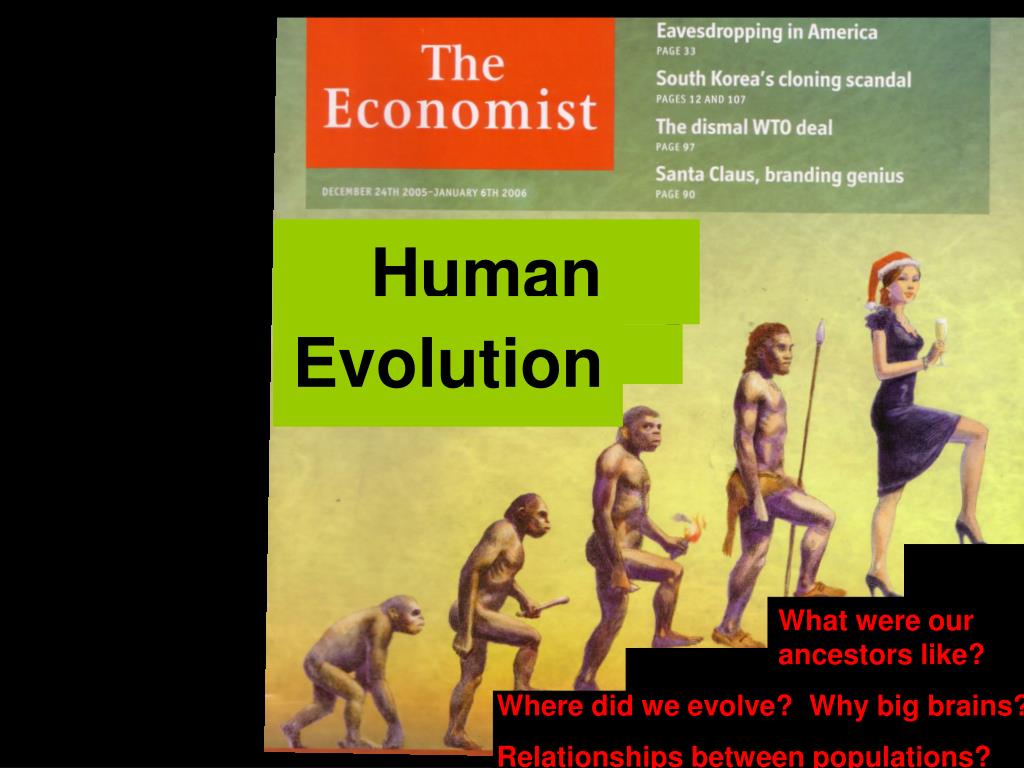
Human Evolution What were our ancestors like? Where did we evolve? Why big brains? Relationships between populations?
Who are the closest living relatives of humans? How do we know? Chimp Gorilla Orang Bonobo
Where are they now? Orangs Gorillas Chimps Bonobos
Early evidence: immunology
Mitochondrial gene phylogeny
Why might different genes yield different phylogenies? 2 3 5
Why might different genes yield different phylogenies?
What was the common ancestor like?
Recent human phylogeny (best guess)
Do we share genes with Neanderthals or Homo erectus? mtDNA from Neanderthal
Relationships among contemporary humans: mitochondrial DNA Europe, Asia, Australia Asian / Australian African
Interpretation of mitochondrial DNA evidence Did we have one female ancestor in the last 200,000 years?
Methods to determine ancestry: coalescent
Common ancestry and genetic markers
Genetic study of human traits • Brain size – two loci of interest • microcephalin (MCPH1) • Abnormal spindle-like microcephaly associated (ASPM) • Selected?
ASPM and selection Ka / Ks McDonald-Kreitman test fixed polymorphic replacements 19 6 silent 7 10 Evans et al 2004
Distribution of ASPM Haplotype: 62kb Mekel-Bobrov et al 2005.
Microcephalin and selection? Ka / Ks Wang and Su 2004.
Microcephalin distribution Haplotype: 29 kb Evans et al 2005
Microcephalin origins Evans et al 2006
Relationships among human populations: Fst
Evolution and races • When did we stop being furry? How to know? . . .
Evolution and races
Evolution and races: natural selection on skin colour
Genetic Basis of Human Skin Colour • Partially known – one of ~6 loci identified • Melanocortin 1 receptor (MC1R) • Unusual pattern of sequence diversity
Human genetic diversity
Forces acting on human populations
Sexual selection and humans Diamond, 1992
Sexual selection and humans Diamond, 1992
References Currat, M. et al. 2006. Comment on “Ongoing adaptive evolution of ASPM” and “Microcephalin, a gene regulating brain size”. Science 313:172a. Diamond, J. 1992. The third chimpanzee. HarperCollins. Evans, P. D. et al. 2004. Adaptive evolution of ASPM, a major determinant of cerebral cortical size in humans. Human molecular genetics 13:489-494. Evans, P. D. et al. 2005. Microcephalin, a gene regulating brain size, continues to evolve adaptively in humans. Science 309:1717-1720. Evans, P. D. et al. 2006. Evidence that the adaptive allele of the brain size gene microcephalin introgressed into Homo sapiens from an archaic Homo lineage. PNAS 103:18178-18183. Jablonski, N. G. and Chapin, G. 2000. The evolution of human skin coloration. Journal of human evolution 39: 57-106. Kittler, R. et al. 2003. Molecular evolution of Pediculus humanus and the origin of clothing. Current Biology 13:1414-1417. McKee, J. K. et al. 2005. Undertanding human evolution (5th ed.) Pearson Prentice Hall. Mekel-Bobrov, N. et al. 2005. Ongoing adaptive evolution of ASPM, a brain size determinant in Homo sapiens. Science 309: 1720-1722. Rosenberg, N. A. et al. 2002. Genetic structure of human populations Science 298: 2381-2385. Templeton, A. 2002. Out of Africa again and again. Nature 416:45-51. Varki and Altheide. 2005. Comparing the human and chimpanzee genomes: searching for needles in a haystack. Genome research 15:1746-1758. Wang, Y and Su, B. 2004. Human molecular genetics 13: 1131-1137.
Study questions • Explain lineage sorting. Why is it more likely to occur with relatively short times between speciation events? How might this explain different results for different genes for the human/chimp/gorilla relationships? • Is it accurate to say that humans evolved from chimps? Why or why not? • In a study of Old World monkeys (Hayasaka et al. 1996) three individual rhesus macaques that were studied did not form a monophyletic group. Instead, one of the rhesus macaques had mtDNA more closely related to Japanese and Taiwanese macaques (which are different species). Give at least two hypotheses explaining this. • Different ethnic groups within Africa are more genetically distinct from each other than all other ethnic groups combined. Explain why this might be the case. • Does the root of the human mtDNA tree in Africa imply that there was a single female alive 200,000 years ago? Explain.
Study questions 6. The human Y-chromosome tree appears younger than the human mtDNA tree. Does this mean that females evolved before males? • Would skin color be a good trait to use for human phylogeny? Explain empirically (using data on the relationships of human populations) and theoretically (the role of traits under strong selection in phylogeny reconstruction). • Are hypotheses of sexual selection shaping human anatomy scientific? • Describe the role of each evolutionary force in human evolution. • What do studies of chimps and bonobos tell us about human nature? What are the limits of these studies?