Advances in Spintronics: From Magnetic Tunnel Junctions to Quantum Computing
This document outlines the advancements in spintronics technologies, including the performance benchmarks of various semiconductor devices and magnetic information storage solutions. It discusses the implications for Moore's Law, superparamagnetic limits, and the utilization of spin-polarized materials in applications like MRAM and quantum computing. The findings highlight the potential for achieving high-performance optoelectronics and single-chip computers through innovative spin injection and coherent manipulation, specifically focusing on structures involving half-metallic materials like CrO2.

Advances in Spintronics: From Magnetic Tunnel Junctions to Quantum Computing
E N D
Presentation Transcript
Spin Electronics Peng Xiong Department of Physics and MARTECH Florida State University QuarkNet, June 28, 2002
SOURCE GATE DRAIN MOSFET Moore’s Law… is the end in sight? Speed: 100 Hz Size: 10-2 m Cost: $106/transistor • Speed: 109 Hz • Size: 10-7 m • Cost: $10-5/transistor
Magnetic Information Storage: superparamagnetic limit • Density: 20 Gb/in2 • Speed: 200 Mb/s • Size: f2.5” x 2 • Capacity: 50 Gb • Density: 2 kb/in2 • Speed: 70 kb/s • Size: f24” x 50 • Capacity: 5 Mb
Superparamagnetic Limit: thermal stability of magnetic media
Semiconductor Random Access Memory: alternatives? M O S • High speed • Low density • High power consumption • Volatile
H R H E E E E H M EF EF N(E) N(E) Metal-based Spintronics: Spin valve and magnetic tunnel junction Applications: magnetic sensors, MRAM, NV-logic
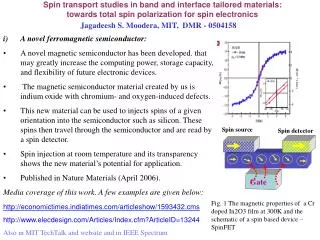
GATE Spintronics in Semiconductor: spin transistor • Dreams • High performance • opto-electronics • Single-chip computer • (instant on; low power) • Quantum computation Datta and Das, APL, 1990 H SOURCE DRAIN GaAs • Issues • Spin polarized material • Spin injection • Spin coherence • Spin detection H
Solutions: • Use injector with 100% • spin polarization • Non-diffusive injection • Conductivity matching Spin Injection: the conductivity mismatch I Schmidt et.al., PRB, 2000 I RN RF I¯ SC mF RN¯ RF¯ mN mF¯ mN¯ FM
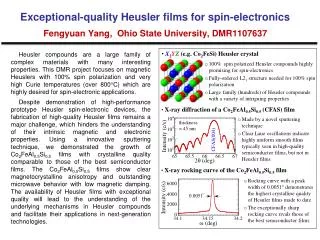
E E CrO2: a half metal Tc = 400 K m = 2mB/Cr p = 100% Uex E 4s Schwarz, J. Phys. F, 1986 normal metal half-metallic ferromagnet 3d metallic ferromagnet Measurement of spin polarization: using a superconductor
Question: • What could happen to an electron with energy eV < D when it hits S from N? • bounce back; • go into S as an electron; • C. go into S in a Cooper pair. • A and B • B and C • C and A • A and B and C Andreev reflection: normal metal/superconductor E S N D eV EF -D N(E) N S
Andreev reflection: normal metal/superconductor p = 0 Z = 0 clean metallic contact Z ~ 1 in-between Z >> 1 tunnel junction Blonder, Tinkham, and Klapwijk, PRB, 1982
Andreev reflection: ferromagnet/superconductor p = 75% E F S Z = 0 metallic contact D eV EF -D Z ~ 1 in-between DOS Z >> 1 tunnel junction V
Comparison: normal metal and ferromagnet p = 75% p = 0 Z = 0 metallic contact Z = 0 metallic contact Z ~ 1 in-between Z ~ 1 in-between Z >> 1 tunnel junction Z >> 1 tunnel junction V V
Spin Polarization of CrO2: our approach Planar junction real device structure Artificial barrier controlled interface Preservation of spin polarization at and across barrier Key step: controlled surface modification of CrO2 via Br etch
CrO2 Film Growth: Chemical Vapor Deposition Furnace, T=280° C O2 flow Heater block, T=400°C substrate Cr8O21 precursor Ivanov, Watts, and Lind, JAP, 2001
~ V Lock-in dV/dI vs V in He4 (1K) or He3 (0.3K) cryostats Junction Fabrication and Measurement • Grow CrO2 film • Pattern CrO2 stripe • Surface modification: Br etch • Deposit S cross stripes Pb or Al Pb or Al I CrO2 CrO2 TiO2
Results: CrO2/(I)/Pb junctions Metallic contact Z = 0 p = 97% T = 1.2 K • = 1.44 meV Tunnel junction T = 400 mK High quality barrier w/o inelastic scattering
mH H Measurement of spin polarization in high-Z junctions: using Zeeman splitting E D eV EF -D eV/D N(E) Meservey and Tedrow, Phys. Rep., 1994 S F
Zeeman splitting in an F/I/S junction CrO2 In order to get high Hc: Ultrathin S film Parallel field Negligible s-o interaction H Al Al CrO2
Results: Zeeman splitting +2.5T -2.5T T =400 mK
Summary (CrO2) Verified half-metallicity of CrO2 Engineered an artificial barrier on CrO2 surface Preserved complete spin polarization at interface Achieved full spin injection from a half metal Future Apply the technique to other systems Magnetic tunnel junction
CrO2/I/Co magnetic “tunnel” junction H Co CrO2 AlOx
The People Jeff Parker Jazcek Braden Steve Watts Pavel Ivanov Stephan von Molnár Pedro Schlottmann David Lind
Let’s build “computers with wires no wider than 100 atoms, a microscope that could view individual atoms, machines that could manipulate atoms 1 by 1, and circuits involving quantized energy levels or the interactions of quantized spins.” Richard Feynman – “There’s Plenty of Room at the Bottom” 1959 APS Meeting