Reality Check
This presentation explores the perceptions of younger generations towards Christianity and the impact of political affiliations on faith. It examines the dominant belief that Christians are primarily politically motivated, the resulting skepticism from youth, and the call for a more authentic expression of Christianity that transcends partisan politics. The discussion focuses on the complexities of Christian voters, the need for transformation in faith practice, and how shifting attitudes towards political engagement could redefine Christianity's public image.

Reality Check
E N D
Presentation Transcript
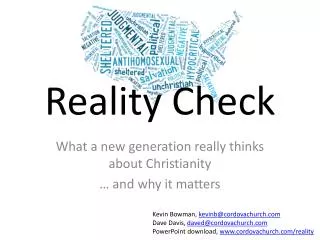
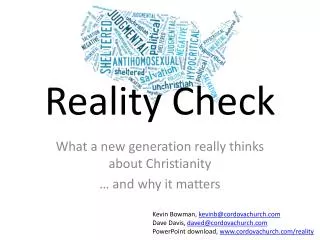
Reality Check What a new generation really thinks about Christianity … and why it matters Kevin Bowman, kevinb@cordovachurch.com Dave Davis, daved@cordovachurch.com PowerPoint download, www.cordovachurch.com/reality
Too political • Current perception • Christians are primarily motivated by a political agenda and promote right-wing politics • Goal perception • Christians are characterized by respecting people, thinking biblically, and finding solutions to complex issues
Why this perception exists • Survey says: best-known Christians • Among well-known public figures, outsiders recognize Christians in politics more than in any other area • Musicians, movie/TV stars, athletes, artists, etc.
Why this perception exists • Christian voters have had a large influence on elections and legislation • The media portrays a one-dimensional Christian voting bloc • “Us vs. them” polarization • A candidate’s faith & beliefs is newsworthy
Why it matters • Our political activism, if expressed in un-Christian ways, can prevent a new generation from seeing Christ: attacking, degrading, acting superior • The new generation is skeptical of people who use political power to protect their interests & viewpoints • Mosaic & Buster insiders value authenticity & see Christianity as having “sold out” or been hijacked by the Republican party • Desire a living faith that offers transformation, not just wins elections
Complexity • Christians voters are frequent victims of over-simplification • Both outsiders & insiders assume Christians voters are an aligned bloc • Voters and the spectrum of faith
Complexity • Christian party affiliation is more diverse than you might expect • Only a slight majority, 59% in 2006, of evangelicals (per the un-Christian definition) are registered Republicans • Christian views aren’t strictly partisan • Christians in either party cite the bible to support their platform
Us vs. Them • It’s easy to assume that society is divided into two camps: liberal Democrats & conservative republicans • Churchgoers are more diverse, less cohesive, and less unified than is typically assume • Outsiders have far less unity, consistency, & commonality than Christians may assume
Worldview • Although Christian voters are the majority, they come with varied worldviews & backgrounds (born again, evangelical, other self-identified Christians) • Political messaging tied to Christian concepts will resonate differently with each group • As Christians with political opinions, our words and thoughts endure & have the power to negatively impact our public image
Climate changes • The political & social views of Mosaics & Busters are much less traditional than those held by their parents at the same age • Prostitution, gambling, drinking, drugs, sexuality • Young people are pragmatic & have a “do what works” mentality; they seek compromise over conflict • Side-effect of their valuing relationships & respect for diversity
Climate changes • Mosaics & Busters are skeptical of the role of the Bible in public life • Should the Bible or the will of the people determine the laws of the country?
Climate changes • Young adults aren’t passionate about America being a “Christianized” country • “In God we trust,” “One nation under God,” 10 commandments in government buildings • Younger adults are less like to demonstrate partisan allegiance to their family precedent • As these views change, the Christian “numerical advantage” will become less relevant
Next week • Christians are too political • Feedback & resources • Kevin Bowman, kevinb@cordovachurch.com • Dave Davis, daved@cordovachurch.com • PowerPoint download, www.cordovachurch.com/reality