Understanding Squares and Square Roots: Essential Concepts and Exercises
This lesson focuses on the concepts of squares and square roots, crucial for mastering basic algebra. Students will review inequalities and practice skills related to calculating areas of squares based on side lengths. Through engaging exercises, students will find the area of squares and determine the length of sides when given certain areas. The lesson also introduces the radical sign and explores the concept of perfect squares and their square roots. Finally, students will learn to approximate square roots between two consecutive integers.

Understanding Squares and Square Roots: Essential Concepts and Exercises
E N D
Presentation Transcript
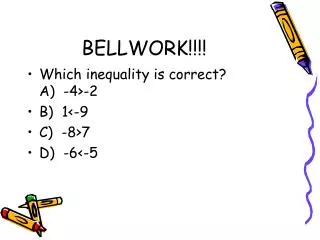
BELLWORK!!!! • Which inequality is correct?A) -4>-2 • B) 1<-9 • C) -8>7 • D) -6<-5
HW REVIEW Timed Skill Drill
Squares & Square Roots DCMS Rocks!
Finding squares and square roots If the length of one side of a square is 2, then its area is _______? If the length of one side of a square is 3, then its area is_______ ? If the length of one side of a square is 4, then its area is_____? 12 = 1 22 = 4 32 = 9 42 = 16 If the area of a square is 4, then the length of one side is_____? If the area of a square is 9, then the length of one side is____? If the area of a square is 16, then the length of one side is_____?
The symbol for the principal, or positive square root, √ is called the radical sign. 52 = 25 If the length of one side of a square is 5, then its area is______? Given: area = 25 Length of side = √25 = 5 For any positive integer there are two square roots, one positive and one negative.
Radicala radical is a root (like a square root) of a number. A radical is made up of a radical sign and something inside called the radicand.
We discussed earlier that the inverse of an operation would “undo” that operation. The inverse operation of squaring a number is the square root ( √) of that number.
Perfect Squares 1 = 1 x 1 = 12 4 = 2 x 2 = 22 9 = 3 x 3 = 32 16 = 4 x 4 = 42 25 = 5 x 5 = 52 = 6 x 6 = 62 = 7 x 7 = 72 = 8 x 8 = 82 = 9 x 9 = 92 100 = 10 x 10 = 102 Radicals (square roots) √1 = 1 √4 = 2 √9 = 3 √16 = 4 √25 = 5 √36 = 6 √49 = 7 √64 = 8 √81 = 9 √100 = 10 You need to remember:
Find two consecutive integers between which √58 can be found. 7 x 7 = 49 too small 8 x 8 = 64 too large Thus, √58 is between 7 and 8. Using a calculator, √58 = 7.62 Find two consecutive integers between which –√77 can be found. Find two consecutive integers between which √35 can be found.
Closure • What does the SQUARE of a number represent? • What does the SQUARE ROOT of a number represent?