

SlideServe
Menu
Préférences
© SlideServe · v2026

AFM

nhung avatar
7 diapositives · 301 Views · Sep 13, 2014

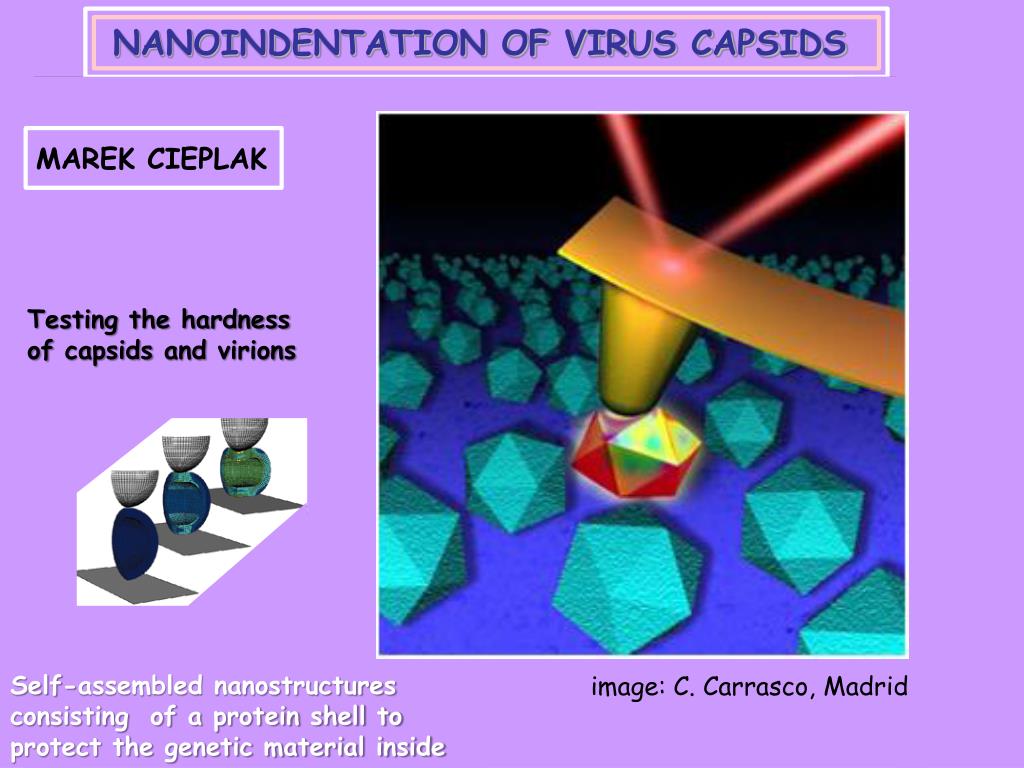
NANOINDENTATION OF VIRUS CAPSIDS. MAREK CIEPLAK. Testing the hardness of capsids and virions. AFM. Self-assembled nanostructures consisting of a protein shell to protect the genetic material inside. image: C. Carrasco, Madrid. CCMV. cowpea chlorotic mottle virus.
AFM - slide 1
01 / 7AFM
1 / 17

Télécharger la présentation

AFM
Une image / un lien ci-dessous est fourni (tel quel) pour télécharger la présentation

Politique de téléchargement : le contenu du site vous est fourni TEL QUEL pour votre information et votre usage personnel ; il ne peut être vendu, concédé sous licence ni partagé sur d’autres sites sans l’accord de son auteur.Le contenu vous est fourni TEL QUEL, pour votre information et votre usage personnel uniquement. Téléchargez la présentation en cliquant sur ce lien. Lors du téléchargement, si vous ne parvenez pas à télécharger une présentation, l’éditeur a peut-être supprimé le fichier de son serveur.Pendant le téléchargement, si vous ne parvenez pas à obtenir une présentation, le fichier a peut-être été supprimé par l’éditeur.

F I N

Plus de contenu associé

Transcription de la présentation
  1. NANOINDENTATION OF VIRUS CAPSIDS MAREK CIEPLAK Testing the hardness of capsids and virions AFM Self-assembled nanostructures consisting of a protein shell to protect the genetic material inside image: C. Carrasco, Madrid

  2. CCMV cowpea chlorotic mottle virus a truncated icosahedron model 20 28 620 Cα atoms, 62460 contacts CPMV cowpea mosaic virus a rhombic triacontahedron model 30 Both ~ 300 000 heavy atoms 33 480 Cα atoms, 90420 contacts 180 sequentially identical chains that self assemble

  3. Coarse-grained structure-based model s Compression by 2 plates, combined speed ~ 500 μm/s. Slow enough that stress can be transmitted across the capsid before the separation has changed substantially minutes needed to recover some clockwise rotation s – separation between the plates 284 Å Top 2150 Cαatoms 264 Å 284 Å 214 Å 239 Å 214 Å 189 Å 164 Å

  4. Breaking of a few bonds leads to stress transfer and a cascade of additional bonds ACTIVATED TRANSITION compression At smaller speeds, more time for thermal activation and transition at lower forces withdrawal 284 Å 264 Å various trajectories 284 Å 214 Å k ~ 0.05 ε/Å2 ~ 0.055 N/m 239 Å Fm ~ 5.5 ε/Å ~ 600 pN Experimental: 0.14 N/m & 500 pN 214 Å 189 Å 164 Å LJ radius in the potential ~ size of an amino acid (not atom) : softer

  5. CCMV ~ 6 neighbors CPMV ~ 8 neighbors (fcc lattice ~ 12 neighbors) including along the backbone ~ 1700 pN 284 Å 264 Å 284 Å 214 Å 239 Å CPMV: an order of magnitude bigger k & Fm 3 times as big despite comparable radius and shell thickness 214 Å 189 Å 164 Å

  6. Radial strain different than for a continuum shell A nearly constant and small expansion in the center and a rapid change in the slope for |h|> 60 Å central bows out 5% Mean rotation ~ 4o polar bows in Z -compression outer 15% increase in the radius Some symmetry breaking due to buckling on one side inner Gibbons, Klug 2008

  7. Cα-based description of empty CCMV & CPMV capsids. Nanoindentation by a large tip modeled as compression between parallel plates. Qualitatively consistent with continuum model. However, the details depend on the specifics of the molecular structure. A 30% increase in the number of contacts results in a 3-fold larger yield point and shorter elastic region – difficult to capture in continuum models Elastic region followed by an irreversible activation transition to the sandwich state – related to rupturing nearly all of the bonds between capsid proteins The molecular model undergoes a gradual symmetry breaking rotation and accomodates more strain near the walls Mark O. Robbins, Johns Hopkins University, Baltimore, USA