Enhancing Digital Curation Education: Insights from DCP Workshops
150 likes | 275 Vues
This presentation by D. Scott Brandt discusses key insights from data curation profiles developed through interviews with researchers. It highlights the challenges faced by small labs in managing research data and the need for effective data curation training. The session explores the development of a curriculum framework and toolkit based on the Data Curation Profile (DCP), aiming to improve the skills and competencies necessary for data management in academic settings. The findings underscore the importance of hands-on learning and trial-and-error approaches in teaching data curation practices.

Enhancing Digital Curation Education: Insights from DCP Workshops
E N D
Presentation Transcript
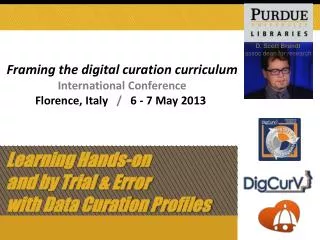
D. Scott Brandtassoc dean for research Framing the digital curation curriculum International Conference Florence, Italy / 6 - 7 May 2013 Learning Hands-on and by Trial & Error with Data Curation Profiles
Who’s willing to share what with whom? 2007: interviews with 20 data producing researchers found they has similar questions/concerns about their data— this resulted in the development of the Data Curation Profile, and became the basis for the subsequent Toolkit. http://datacurationprofiles.org
Single PI/Small lab scenarios • “small science” –single PI in a fairly small lab setting • Such researchers self report: no specific person for data management/curation; data is likely saved to hard drives in the lab and backed up on CDs, usually by the students. While students have received “research integrity” training (which focuses on making data available upon request by funder, publisher, or FOIA, etc.) it is not likely that anyone could retrieve usable data easily or quickly.* *D. Scott Brandt. Provost Fellowship, Final Report 2009 (unpublished)
Hands on Trail & Error DCPinterview Researchdatarepository DataCurationProfile Researcharticle
Initial goal: create DCP, toolkit, workshops on how to use, resource of Profiles DCP Can the Curriculum Framework help assess ‘curriculum’ going forward? Toolkit DIY instructions Workshop lesson plan Understanding data curation/managementin academic setting Tutorial learning objectives
Curriculum Framework and DCP… Knowledge and principles Skills and competences Audience/profile types Part of digital curation lifecycle Teaching methods/training delivery Professional context DIY DCP DCP workshop DCP tutorial other?
Framework, Profiles and Preservation… • Knowledge: data curation, the DCP as instrument, research project, data lifecycle… • Skills and competences: depends on context • Audience/profile types: multiple perspectives • Part of digital curation lifecycle: curation? research? data? scholarly communication? • Teaching methods/training delivery: lecture, reading, modeling, scenarios, video, exercises, problem solving, reflection and peer review • Professional context: which perspective
Digital --- Curation --- Preservation understanding negotiation DataRepository Researcher 2.Descriptionof data 7. Sharing & Access 4.4 Attribution 12. Data Mgmt 3.2 Data kinds3.3 Target data 5. Organization and Description 8. Discovery 13. Preservation 4. IntellectualProperty 6. Ingest/Transfer 10. Interoperability
Tell me where is curation bred, in the heart or in the head? To best use Framework for Data Curation Profile training, I need to more clearly identify • what is curricular, what is extra-curricular… • what is requisite and prerequisite • if multiple perspectives can be represented • how much about digital curation a librarian needs to interview a researcher about her/his research data and workflow and sharing
DCP Directory launched January 2013 30 published Profiles as of February Purdue Libraries Publishing Services provides platform and sustainability Profiles are citable publications w/ DOIs Editorially reviewed docs.lib.purdue.edu/dcp/
Michael Witt, Jake Carlson, D. Scott Brandt One of those times where, even if your parents don’t understand what you do, they can at least say, “well you must half way know what you’re doing…”
grazie mille D. Scott Brandt techman@purdue.edu Framing the digital curation curriculum International Conference Florence, Italy / 6 - 7 May 2013