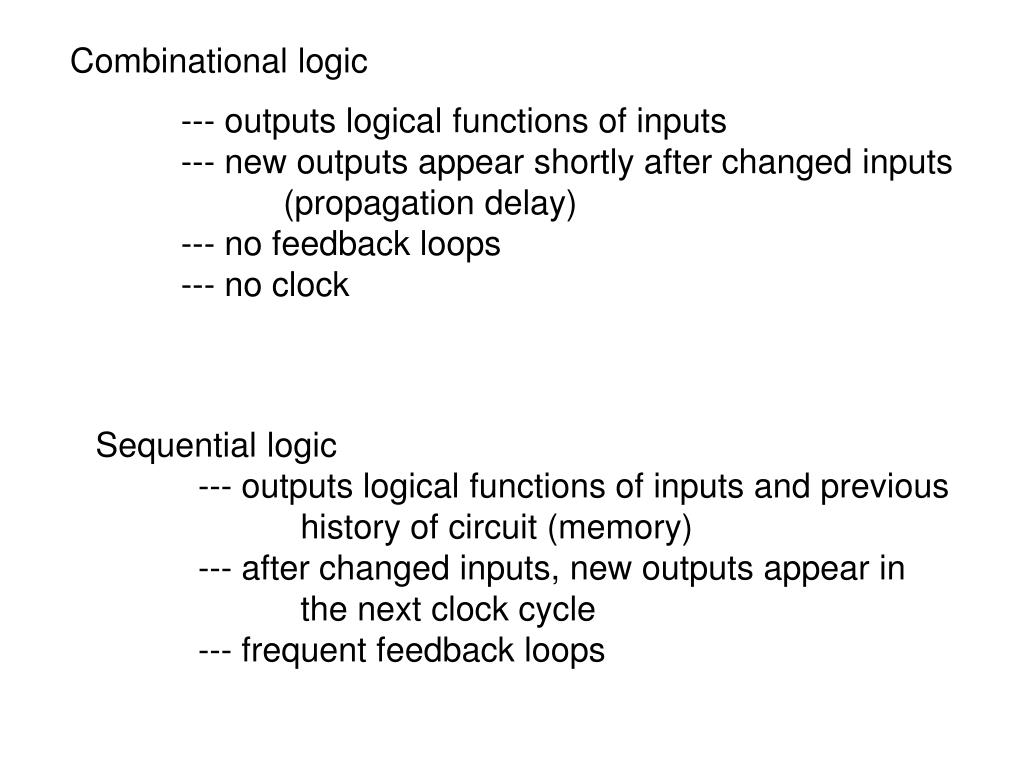
Combinational logic --- outputs logical functions of inputs --- new outputs appear shortly after changed inputs (propagation delay) --- no feedback loops --- no clock Sequential logic --- outputs logical functions of inputs and previous history of circuit (memory) --- after changed inputs, new outputs appear in the next clock cycle --- frequent feedback loops
Fundamentals of Boolean algebra • Named after George Boole • He presented an algebraic formulation of the process of “logical thought and reason” • This formulation come to be known as Boolean Algebra
Postulates of Boolean algebra • Definition • A Boolean algebra is a closed algebraic system containing a set K of two or more elements and the two operators ‘•’ or ‘/\’ or ‘’, called AND, and ‘+’ or ‘\/’ or ‘’, called OR; • Closed system: for every a and b in set K, a•b belongs to K and a+b belongs to K.
Postulates of Boolean algebra • Existence of 1 and 0 • There exist unique elements 1 (one) and 0 (zero) in set A" such that for every a in K a) a + 0 = a, b) a • 1 = a, • where 0 is the identity element for the + operation and 1 is the identity element for the • operation.
Postulates of Boolean algebra • Commutativity of the + and • operations • For every a and b in K a) a + b = b + a. b) a • b = b • a • Associativity of the + and operations • For every a, b, and c in K a) a + (b + c) = (a + b) + c. b) a • (b • c) = (a • b) • c.
Postulates of Boolean algebra • Distributivity of + over • and • over + • For every a, b, and c in K a) a + (b • c) = (a + b) • (a + c), b) a • (b + c) = (a • b) + (a • c). • Existence of the complement • For every a in K there exists a unique element called ā (complement of a) in K such that a) a + ā = 1. b) a • ā = 0.
Venn diagrams for the postulates • Operations on sets Sets closed regions Sets correspond to elements Intersection corresponds to • Union corresponds to +
Venn diagrams for the postulates
Venn diagrams Examples of Venn diagrams
Venn diagrams a + b • c = (a + b) • (a + c)
Venn diagrams a + b • c = (a + b) • (a + c)
Boolean algebra • Duality • If an expression f(x1, x2, … xn, +, •, 0, 1) is valid, then f(x1, x2, … xn, •, +, 1, 0) obtained by interchanging + and •, 0 and 1 is also valid a • (b + c) = (a • b) + (a • c) a + (b • c) = (a + b) • (a + c) Postulates 2 – 6 are stated in dual form
Fundamental theorems of Boolean algebra • Prove part (b) by exchanging + with •, and use the dual form of the postulates
Fundamental theorems of Boolean algebra
Fundamental theorems of Boolean algebra a • ā = 0 [P6(b)] a + ā = 1 [P6(a)] Therefore, ā is the complement of a, and also a is the complement of ā. Because the complement of ā is unique, it must be equal to a.
Fundamental theorems of Boolean algebra
Fundamental theorems of Boolean algebra • Why a + ab = a a ab b
Fundamental theorems of Boolean algebra
Fundamental theorems of Boolean algebra
Fundamental theorems of Boolean algebra
Fundamental theorems of Boolean algebra
Fundamental theorems of Boolean algebra
Fundamental theorems of Boolean algebra • Example using DeMorgan’s theorem
Fundamental theorems of Boolean algebra
Boolean algebra postulates and theorems
Theorems • Proofs by perfect induction Proofs by exhaustion: Let variables assume all possible values and show validity of result in all cases
(a) Keep axioms handy Example: Show X + 0 = X (b) Elaborate cases: if X = 0, have X + 0 = 0 + 0 = 0 = X if X = 1, have X + 0 = 1 + 0 = 1 = X
More Theorems Can prove by exhaustion....but have more cases For distributive laws, T8 looks like ordinary algebra T8’ also true (swap operators, factor, swap back) T9, T10 for logic minimization - drop irrelevant terms
T9, T10, T11 for logic minimization - drop superfluous terms T9 (Covering): X + XY = X and X(X+Y)=X Proof: X + XY = X1 + XY = X(1+Y) = X1 = X X(X+Y) = (X+0)(X+Y) = X+(0Y) = X+0 = X T10 (Combining): XY + XY’ = X and (X + Y) (X + Y’) = X Proof: XY + XY’ = X(Y + Y’) = X1 = X (X + Y)(X + Y’) = X + (YY’) = X + 0 = X T11 (Consensus): XY+X’Z+YZ = XY+X’Z and (X+Y)(X’+Z)(Y+Z)= (X+Y)(X’+Z) Proof: If YZ = 0 XY+X’Z+YZ = XY+X’Z+ 0 = XY+X’Z else Y = Z = 1 left side: XY+X’Z+YZ = something + YZ = something + 1 =1 right side: XY+X’Z = X + X’ = 1 So, in either case, XY+X’Z+YZ = XY+X’Z If Y+Z = 1 (X+Y)(X’+Z)(Y+Z)= (X+Y)(X’+Z)1= (X+Y)(X’+Z) else Y = Z = 0 left side: (X+Y)(X’+Z)(Y+Z)= something (Y + Z) = something 0 = 0 right side: (X+Y)(X’+Z) = (X+0)(X’+0) = XX’ = 0 So, in either case, (X+Y)(X’+Z)(Y+Z)= (X+Y)(X’+Z)
X + (X×Y) = X (T9)X× (X + Y) = X (dual)(X× X) + (X× Y) = X (T8)X+ (X× Y) = X (T3¢) parentheses,operator precedence Duality • De Morgan’s Theorems: (X + Y)’ = X’ Y’ (X Y)’ = X’ + Y’ • Dual: Swap 0 & 1, AND & OR, but leave variables unchanged • Result: Theorems still true • Why? • f(X, Y) = g(X, Y) • complement[f(X, Y)] = complement[g(X, Y)] • dual[f(X’, Y’)] = dual[g(X’, Y’)] • but X’, Y’ just dummy variables, replace with originals • Counterexample?X + X × Y = X (T9)X × X + Y = X (dual)X + Y = X (T3¢)!! error ?
N-variable Theorems • Prove via induction • Most important: DeMorgan theorems
DeMorgan Symbol Equivalence Bubble-pushing...
Likewise for OR