Understanding Density: Measurement and Conversion in Science
In today's lesson, we'll explore the concept of density, its formula, and how it can be determined through various methods. We will work on converting measurement units, including converting 5.789 mm to meters and 623 L to milliliters. The agenda includes completing Lab #3 on measurement, notes on density, and filling out a density worksheet. Understanding the factors affecting density—such as temperature and pressure—will be key. Don't forget to finish the homework on the density worksheet!

Understanding Density: Measurement and Conversion in Science
E N D
Presentation Transcript
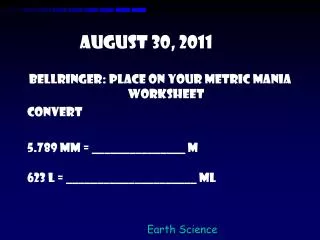
August 30, 2011 Bellringer: Place on your metric mania worksheet Convert 5.789 mm = _______________ m 623 L = _____________________ ml
Objectives: Determine density of various objects Agenda Finish Lab #3: measurement Density notes Density worksheet Homework: Finish Density Worksheet
What is density? • The amount of matter (stuff) in a specific space • Formula: Density = Mass Volume
Formula • D= density • M= mass • V= volume • D= m/v • M= d x v • V= m/d m d v
Density of Water • H2O = water • 1 g/ml or • 1 g/cm3
All about Density • It does not depend on size or shape • Maximum (highest) density is in Solids • Gases have the lowest density • But water is the exception
To Measure Density: • By flotation- put the object in a liquid. • If it floats- its density is less than the density of the liquid • If it sinks- its density is more than the density of the liquid.
Things that affect density • Heating- of a solid, liquid, or gas make it expand (spread out). The volume gets larger, so the density gets smaller.
Things that affect density • Cooling – a solid, liquid, or gas makes it contract (get smaller). The volume gets smaller, so the density gets higher.
Things that affect density • Increasing pressure on a gas makes the volume get smaller. The density gets higher.
Review • What is the formula for density? • How can you find mass if you know the volume and density?
Review • How can you find volume if you know the mass and density? • An object has a mass of 3 g and a volume of 6 cm3. What is the density? • What is the mass of an object that has a density of 3 mg/cm3 and a volume of 2 cm3?