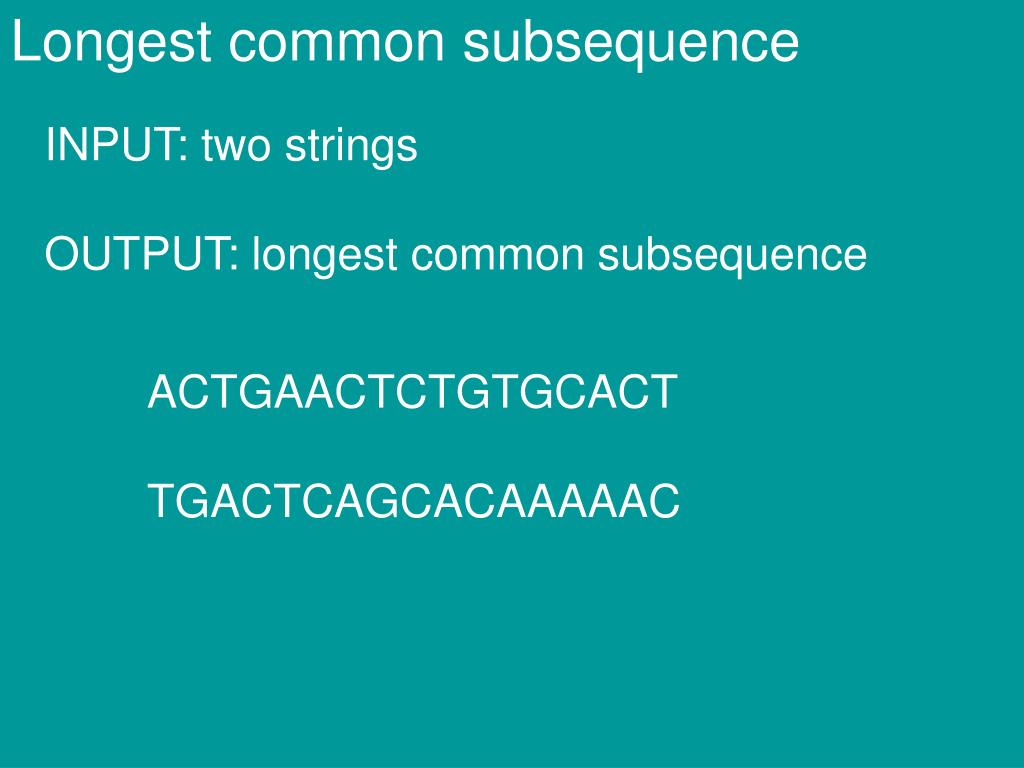
Longest common subsequence. INPUT: two strings OUTPUT: longest common subsequence. ACTGAACTCTGTGCACT TGACTCAGCACAAAAAC. Longest common subsequence. INPUT: two strings OUTPUT: longest common subsequence. AC TGA A CTC T G TG CAC T TGACTC A GCAC AAAAAC. Longest common subsequence.
Une image / un lien ci-dessous est fourni (tel quel) pour télécharger la présentation
Politique de téléchargement : le contenu du site vous est fourni TEL QUEL pour votre information et votre usage personnel ; il ne peut être vendu, concédé sous licence ni partagé sur d’autres sites sans l’accord de son auteur.Le contenu vous est fourni TEL QUEL, pour votre information et votre usage personnel uniquement.Téléchargez la présentation en cliquant sur ce lien.Lors du téléchargement, si vous ne parvenez pas à télécharger une présentation, l’éditeur a peut-être supprimé le fichier de son serveur.Pendant le téléchargement, si vous ne parvenez pas à obtenir une présentation, le fichier a peut-être été supprimé par l’éditeur.
F I N
Plus de contenu associé
Transcription de la présentation
Longest common subsequence INPUT: two strings OUTPUT: longest common subsequence ACTGAACTCTGTGCACT TGACTCAGCACAAAAAC
Longest common subsequence INPUT: two strings OUTPUT: longest common subsequence ACTGAACTCTGTGCACT TGACTCAGCACAAAAAC
Longest common subsequence Sequences x1,…,xn, and y1,…,ym LCS(i,j) = length of a longest common subsequence of x1,…,xi and y1,…,yj
Longest common subsequence Sequences x1,…,xn, and y1,…,ym LCS(i,j) = length of a longest common subsequence of x1,…,xi and y1,…,yj if xi = yj then LCS(i,j) =
Longest common subsequence Sequences x1,…,xn, and y1,…,ym LCS(i,j) = length of a longest common subsequence of x1,…,xi and y1,…,yj if xi = yj then LCS(i,j) = 1 + LCS(i-1,j-1)
Longest common subsequence Sequences x1,…,xn, and y1,…,ym LCS(i,j) = length of a longest common subsequence of x1,…,xi and y1,…,yj if xi yj then LCS(i,j) = max (LCS(i-1,j),LCS(i,j-1)) xi and yj cannot both be in LCS
Longest common subsequence Sequences x1,…,xn, and y1,…,ym LCS(i,j) = length of a longest common subsequence of x1,…,xi and y1,…,yj if xi = yj then LCS(i,j) = 1 + LCS(i-1,j-1) if xi yj then LCS(i,j) = max (LCS(i-1,j),LCS(i,j-1))
Longest common subsequence Running time ? Sequences x1,…,xn, and y1,…,ym LCS(i,j) = length of a longest common subsequence of x1,…,xi and y1,…,yj if xi = yj then LCS(i,j) = 1 + LCS(i-1,j-1) if xi yj then LCS(i,j) = max (LCS(i-1,j),LCS(i,j-1))
Longest common subsequence Running time = O(mn) Sequences x1,…,xn, and y1,…,ym LCS(i,j) = length of a longest common subsequence of x1,…,xi and y1,…,yj if xi = yj then LCS(i,j) = 1 + LCS(i-1,j-1) if xi yj then LCS(i,j) = max (LCS(i-1,j),LCS(i,j-1))
Optimal matrix multiplication N x N matrix N x N matrix N x 1 matrix B C A Compute AB, time = (N3) Compute ABC, time = ?
Optimal matrix multiplication N x N matrix N x N matrix N x 1 matrix B C A Compute D=BC, time = ? Compute AD, time = ? Compute ABC, time = ?
Optimal matrix multiplication N x N matrix N x N matrix N x 1 matrix B C A Compute D=BC, time = (N2) Compute AD, time = ? Compute ABC, time = ?
Optimal matrix multiplication N x N matrix N x 1 matrix D A Compute D=BC, time = (N2) Compute AD, time = ? Compute ABC, time = ?
Optimal matrix multiplication N x N matrix N x 1 matrix D A Compute D=BC, time = (N2) Compute AD, time = (N2) Compute ABC, time = (N2)
Optimal matrix multiplication N x N matrix N x N matrix N x 1 matrix B C A (AB)C = ABC = A(BC) The order of evaluation does not change the result can change the amount of work needed
Optimal matrix multiplication a1,a2,a3,….,an n-1 matrices of sizes a1 x a2 B1 a2 x a3 B2 a3 x a4 B3 …. an-1 x an Bn-1 What order should we multiply them in?
Optimal matrix multiplication B1 B2 B3 B4 … Bn-1 K[i,j] = the minimal number of operations needed to multiply Bi … Bj Bi (Bi+1 Bi+2 … Bj ) (Bi Bi+1) (Bi+2 … Bj ) (Bi Bi+1 Bi+2) ( … Bj ) … (B1 B2 B3 …) Bj K[i,i] + K[i+1,j] + aiai+1aj+1 K[i,i+1] + K[i+2,j] + aiai+2aj+1 K[i,i+2] + K[i+3,j] + aiai+3aj+1 K[i,j-1] + K[j,j] + aiajaj+1
Optimal matrix multiplication B1 B2 B3 B4 … Bn-1 K[i,j] = the minimal number of operations needed to multiply Bi … Bj K[i,j] = min K[i,w] + K[w+1,j] + ai aw+1 aj K[i,i]=0 iw< j
Travelling Salesman Problem INPUT: N cities, NxN symmetric matrix D, D(i,j) = distance between city i and j OUTPUT: the shortest tour visiting all the cities
Travelling Salesman Problem Algorithm 1 – try all possibilities for each permutation of {1,...,n} visit the cities in the order , compute distance travelled, pick the best solution running time = ?
Travelling Salesman Problem Algorithm 1 – try all possibilities for each permutation of {1,...,n} visit the cities in the order , compute distance travelled, pick the best solution running time n! is (n+1)! = O(n!) ?
Travelling Salesman Problem for each subset S of the cities with |S| 2 and each u,v S K[S,u,v] the length of the shortest path that * starts at u * ends at v * visits all cities in S How large is K ?
Travelling Salesman Problem for each subset S of the cities with |S| 2 and each u,v S K[S,u,v] the length of the shortest path that * starts at u * ends at v * visits all cities in S How large is K ? 2n n2
Travelling Salesman Problem K[S,u,v] some vertex w S – {u,v} must be visited first d(u,w) = we get to w K[S-u,w,v] = we need to get from w to v and visit all vertices in S-u
Travelling Salesman Problem K[S,u,v] the length of the shortest path that * starts at u * ends at v * visits all cities in S if S={u,v} then K[S,u,v]=d(u,v) if |S|>2 then K[S,u,v] = min K[S-u,w,v] + d(u,w) wS-{u,v}
Travelling Salesman Problem if S={u,v} then K[S,u,v]=d(u,v) if |S|>2 then K[S,u,v] = min K[S-u,w,v] + d(u,w) wS-{u,v} Running time = ? K 2n n2
Travelling Salesman Problem if S={u,v} then K[S,u,v]=d(u,v) if |S|>2 then K[S,u,v] = min K[S-u,w,v] + d(u,w) wS-{u,v} Running time = O(n3 2n) K 2n n2
Longest increasing subsequence INPUT: numbers a1, a2, ... , an OUTPUT: longest increasing subsequence K[0..n,0..n] K[i,j] = the minimum last element of an increasing seqence in a1, ... ,ai of length j (if no sequence )
Longest increasing subsequence K[0..n,0..n] K[i,j] = the minimum last element of an increasing seqence in a1, ... ,ai of length j (if no sequence ) true/false: K[i,j] K[i,j+1] ?
Longest increasing subsequence K[0..n,0..n] K[i,j] = the minimum last element of an increasing seqence in a1, ... ,ai of length j (if no sequence ) K[0,j] = ? for j 1 K[0,0] = ?
Longest increasing subsequence K[0..n,0..n] K[i,j] = the minimum last element of an increasing seqence in a1, ... ,ai of length j (if no sequence ) K[0,j] = for j 1 K[0,0] = -
Longest increasing subsequence K[0..n,0..n] K[i,j] = the minimum last element of an increasing seqence in a1, ... ,ai of length j (if no sequence ) K[i,j] = ?
Longest increasing subsequence K[0..n,0..n] K[i,j] = the minimum last element of an increasing seqence in a1, ... ,ai of length j (if no sequence ) K[i,j] = ai if ai < K[i-1,j] and ai > K[i-1,j-1] K[i,j] = K[i-1,j] otherwise
Longest increasing subsequence K[0..n,0..n] K[i,j] = the minimum last element of an increasing seqence in a1, ... ,ai of length j (if no sequence ) K[i,0] = - K[i,1] = K[i,2] = ... K[i,j] = K[i,j+1] = ai < K[i-1,j] and ai > K[i-1,j-1]