Download
1 / 4
40 likes | 152 Vues
This lesson explores the concept of pH and the unique properties of water, such as cohesion and adhesion, which result from hydrogen bonding. Students will learn how to determine pH levels, understand the differences between acids and bases, and why ice floats in water. Key vocabulary includes solute, solvent, and concentration of ions. Assignments include review questions and a project on acid-base solutions for the Science Fair. Ensure to complete data analysis with a chart for various household items tested for pH levels.

E N D
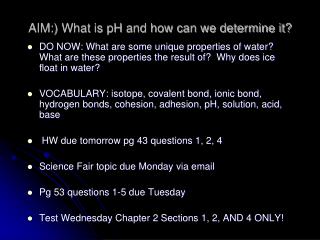
AIM:) What is pH and how can we determine it? • DO NOW: What are some unique properties of water? What are these properties the result of? Why does ice float in water? • VOCABULARY: isotope, covalent bond, ionic bond, hydrogen bonds, cohesion, adhesion, pH, solution, acid, base • HW due tomorrow pg 43 questions 1, 2, 4 • Science Fair topic due Monday via email • Pg 53 questions 1-5 due Tuesday • Test Wednesday Chapter 2 Sections 1, 2, AND 4 ONLY!
Useful Definitions • Solutions • Solute, solvent • Concentration of ions in pure water • pH = [H+] • Acid = anything that forms H+ ions in solution; has higher concentration of H+ than pure water • Base = anything that produces OH- ions in solution, or reduces the H+ ion concentration; has higher {OH} than pure water
pH scale • Supplies • Samples:, vinegar, windex, orange juice, diet soda etc. • Universal Indicator • Predict whether each sample will be acidic or basic • Complete a data chart with 3 columns in your notebook: item, hypothesis, result