Download
1 / 4
40 likes | 164 Vues
This text examines the key question of whether capitalism is the sole route to economic development, particularly through the lens of Russian industrialization and the historical trajectories that shaped it. Highlighting pivotal moments like the February and October Revolutions and the role of scientific socialism, the discussion also reflects on contemporary debates about the viability of the Russian model in today’s world. It scrutinizes the necessity of state intervention for rapid economic growth and Russia's enduring influence in global politics as a counter to Western capitalism.

E N D
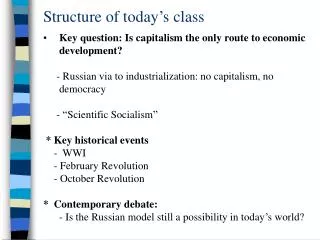
Structure of today’s class • Key question: Is capitalism the only route to economic development? • - Russian via to industrialization: no capitalism, no democracy • - “Scientific Socialism” • * Key historical events • - WWI • - February Revolution • - October Revolution • * Contemporary debate: • - Is the Russian model still a possibility in today’s world?
1) 1839: Great Britain & Belgium • 2) 1879: Germany & Austria-Hungary • 3) 1882: Triple Alliance: Germany, Austria-Hungary & Italy • 4) 1892: Secret Treaty between France and Russia • 5) 1894: Franco-Russian Alliance • 6) 1904: Entente Cordiale: UK & France • 7) 1907: Anglo-Russian Entente • 8) 1907: expansion: Triple Entente: UK, Russia & France • 9) 1914: alliance Ottoman Empire-Germany European powers: alliances
Summary • Russian Revolution of 1917: central event of the 20th century world politics (1989) • Industrialization: possible without free market • State’s growth of teh economy: can lead to rapid economic growth (contrary to A. Smith’s view) • Russia: one the key powers in Eurasia; change in the balance of power • Threat to the West: a) alternative to capitalism b) alternative to democracy • Western powers: “sanitary belt” around Russia • Russia: export Revolution