Cosmetology
Cosmetology. Thermal Hairstyling. What are thermal irons?. Thermal Irons temporarily add curl to hair Thermal Irons were introduced by Marcel Grateau in 1875 Today, thermal irons are often called “ Marcel Curling Irons ”

Cosmetology
E N D
Presentation Transcript
Cosmetology Thermal Hairstyling
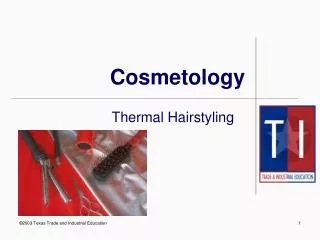
What are thermal irons? • Thermal Irons temporarily add curl to hair • Thermal Irons were introduced by Marcel Grateau in 1875 • Today, thermal irons are often called “Marcel Curling Irons” • Thermal curling is achieved by applying a heated iron to dry hair by an electric curling iron of a marcel iron that is heated in a stove. Cosmetology I: Thermal Hairstyling
Parts of a curling iron • Rod handle • Shell handle • Barrel or rod: the round heating cylinder. • Groove or shell: the clamp that holds the hair against the barrel. • Swivel: electric irons have a swivel at the base of the handle that allows the electric cord to turn as it is being manipulated. Cosmetology I: Thermal Hairstyling
Qualities of a good curling iron • Thermal irons are made of quality steel so they will hold an even temperature and give the best performance. Cosmetology I: Thermal Hairstyling
Curling irons: Sizes & Shapes • The various sizes of shapes and sizes of irons allows versatility in styling such as straightening with a flat iron, making zig zag patterns or crimps. Cosmetology I: Thermal Hairstyling
Electric curling irons • Electric curling irons have a heating element with a controlled thermostat that allows the iron to maintain a constant temperature • A good electric iron should be able to be left on for a long period and maintain the correct temperature. • SAFETY: The electric curling iron should be tested on a tissue paper. After being heated, if the iron scorches the tissue paper it will burn the hair. Cosmetology I: Thermal Hairstyling
Marcel curling irons • Marcel irons are heated in a stove • SAFETY: The temperature of a marcel iron must be tested on a tissue paper. After being heated, if the iron scorches the tissue paper it will burn the hair. • SAFETY: Fine, lightened and damaged hair are able to withstand less heat than healthy hair. • Always be aware of the client’s hair texture when performing a thermal curling service. Cosmetology I: Thermal Hairstyling
Care of curling irons • Always keep irons clean and free from rust and carbon. • Washing the irons in a soap solution containing a few drops of ammonia will remove dirt and grease. • Rust and carbon can be removed with fine sandpaper, or steel wool with a little oil. This procedure will also polish the iron. • Take care not to overheat the irons. New irons are tempered in the factory, and overheating them will cause them to lose their temper and become ruined. Cosmetology I: Thermal Hairstyling
Curling iron: Proper holding • Practice each method to determine which one is the most comfort and control. • Practice turning the iron in a downward circular motion. You will have to shift your thumb to help in the turning motion. • Do not move or sway the iron while rolling; all movement is done with the fingers. Cosmetology I: Thermal Hairstyling
Exercise using a cold iron • Start with the iron on top of the hair strand. • When making the curl, rotate the iron one half-turn and then one full turn back to starting position. • Open irons slightly and slide down no more than and inch, then clamp. • Turn irons backward for a full turn toward you. • Return irons to starting position. • Release. Cosmetology I: Thermal Hairstyling