Understanding Harmonic Motion and Roentgenium: Key Concepts in Physics
30 likes | 162 Vues
This session focuses on the concept of harmonic motion, defined as motion that repeats itself over time. We will explore practical examples of harmonic motion to deepen understanding. Additionally, we will examine Roentgenium (Rg), a synthetic element with a half-life of 26 seconds, discovered in 1994 in Darmstadt, Germany. Named after Wilhelm Röntgen, who won the first Nobel Prize in Physics for his discovery of x-rays, Roentgenium is an intriguing addition to the periodic table we will discuss.


Understanding Harmonic Motion and Roentgenium: Key Concepts in Physics
E N D
Presentation Transcript
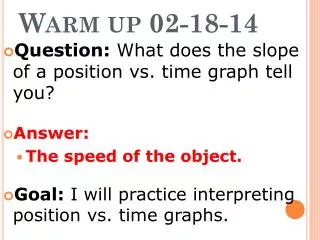
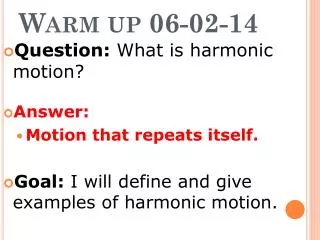
Warm up 06-02-14 • Question: What is harmonic motion? • Answer: • Motion that repeats itself. • Goal: I will define and give examples of harmonic motion.
Element of the day • 111 – Roentgenium - Rg • Its most stable element has a half-life of 26 seconds. • It was discovered in 1994 in Darmstadt, Germany, and is named after Wilhelm Röntgen. • Röntgen won the first ever Nobel prize in physics for discovering x-rays in 1901.
Warm up / New & Good / YB • Packet & warm up check • Notes 23.1 • Packet work • Tonight’s HW • NEW: pgs4-10 • OLD: pgs 1-3 • Late packets Agenda / HW