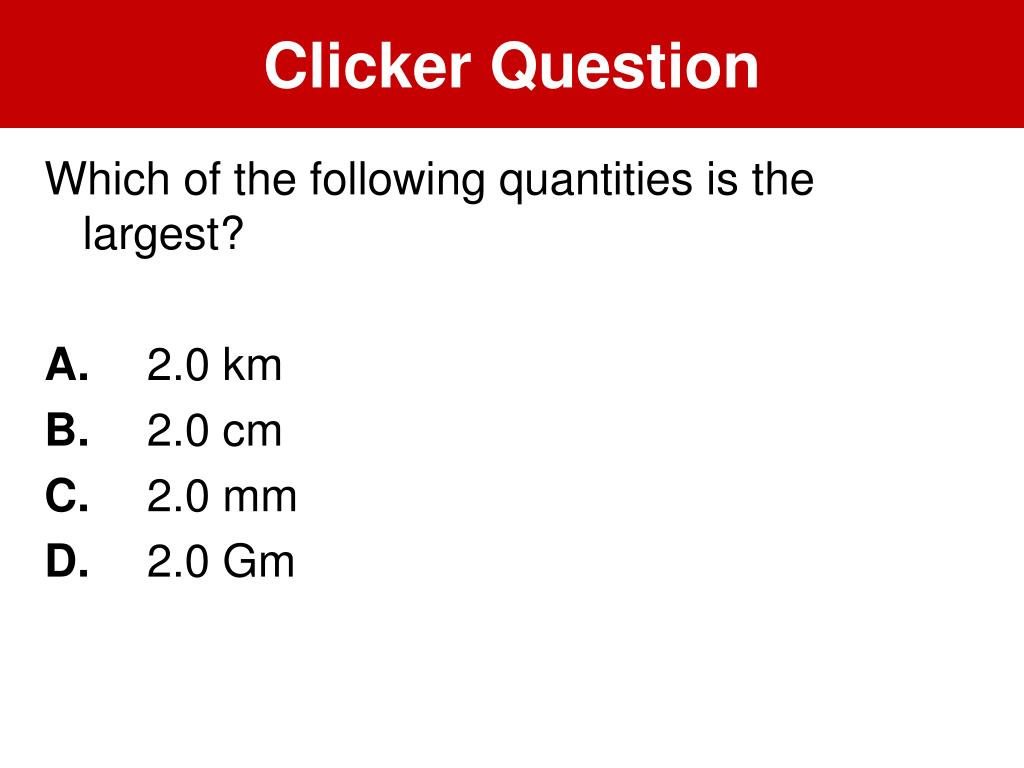
Clicker Question. Which of the following quantities is the largest? A. 2.0 km B. 2.0 cm C. 2.0 mm D. 2.0 Gm. Example 2a . (Clicker Question). The number of significant figures in 400000 m is: A. 1 B. 2 C. 4 D. 6. Example 2b . (Clicker Question).
Une image / un lien ci-dessous est fourni (tel quel) pour télécharger la présentation
Politique de téléchargement : le contenu du site vous est fourni TEL QUEL pour votre information et votre usage personnel ; il ne peut être vendu, concédé sous licence ni partagé sur d’autres sites sans l’accord de son auteur.Le contenu vous est fourni TEL QUEL, pour votre information et votre usage personnel uniquement.Téléchargez la présentation en cliquant sur ce lien.Lors du téléchargement, si vous ne parvenez pas à télécharger une présentation, l’éditeur a peut-être supprimé le fichier de son serveur.Pendant le téléchargement, si vous ne parvenez pas à obtenir une présentation, le fichier a peut-être été supprimé par l’éditeur.
F I N
Plus de contenu associé
Transcription de la présentation
Clicker Question • Which of the following quantities is the largest? • A. 2.0 km • B. 2.0 cm • C. 2.0 mm • D. 2.0 Gm
Example 5c. (Clicker Question) • 700.0 μL in mL is: • A. 7.000 x 10⁻⁷mL • B. 7.000 x 10⁻⁵mL • C. 0.7000 mL • D. 7.000 x 10⁵mL
Clicker Question • Sulfur will most likely __ electrons to become stable. • A.gain two • B.gain six • C. lose two • D. lose six
Clicker Question • Magnesium will prefer to __ electrons and will have a __ charge. • A. Gain two; -2 • B. Gain two; +2 • C. Lose two; -2 • D. Lose two; +2
Example 2. (Clicker Question) • The chemical formula formed by magnesium ion andchloride ion is: • A. MgCl2 • B. Mg2Cl • C.MgC2 • D. Mg2C
Example 2. (Clicker Question) • The chemical formula formed by iron (III) ion andchloride ionis: • A. FeCl3 • B. Fe3Cl • C. IrCl3 • D.Ir3Cl
Example 3b. (Clicker Question) • The name of Ba3N2 is: • A. Barium nitride • B.Barium(III) nitride • C.Barium(II) nitride • D. Barium nitrogen • E. Tribariumdinitrogen
Example 4c. (Clicker Question) • The charge on the transition metal is __. • The name of the compound is __. • A. +2; vanadium(II) sulfide • B. +2; vanadium(II) sulfur • C. +4; vanadium(IV) sulfide • D. +4; vanadium(IV) sulfur
Example 4d. (Clicker Question) • The charge on the transition metal is __. • The name of the compound is __. • A. +1; magnesium(I) fluoride • B.+1; manganese(I) fluoride • C. +7; magnesium(VII) fluoride • D. +7; manganese(VII) fluoride
Example 6. (Clicker Question) • The name of PCl5 is: • A. Monophosphorus pentachloride • B. Monopotassium pentachloride • C. Phosphorus pentachloride • D. Potassium pentachloride
Example 7. (Clicker Question) • The chemical formula formed by iron (III) ion and ClO3- is: • A. FeClO4 • B. FeClO7 • C. FeCl3O12 • D. Fe(ClO4)3
Example 7. (Clicker Question) • The chemical formula formed by sodium ion and sulfate ion is: • A. NaSO4 • B. Na2SO4 • C. Na(SO4)2 • D. Na2(SO4)2 • E. NaS2O4
Example 7. (Clicker Question) • The chemical formula formed by iron (II) ion and sulfate ion is: • A. FeSO4 • B. FeS2O4 • C. Fe2(SO4)2 • D. Fe2(SO4)3 • E. Fe3(SO4)3
Example 7. (Clicker Question) • The chemical formula formed by iron (III) ion and sulfate ion is: • A. FeSO4 • B. Fe2(SO4)2 • C. Fe2(SO4)3 • D. Fe3(SO4)3 • E. Fe3S3O4
Example 8b. (Clicker Question) • The name of Mg(ClO4)2 is: • A. Magnesium perchlorate • B. Magnesium (II) perchlorate • C. Manganese perchlorate • D. Manganese (II) perchlorate
Example 8c. (Clicker Question) • The name of Fe(OH)3 is: • A. Iron hydroxide • B. Iron (I) hydroxide • C. Iron (III) hydroxide • D. Iron trihydroxide
Example 8d. (Clicker Question) • The name of NH4Cl is: • A. Ammonium chlorate • B. Ammonium chloride • C. Nitrogen perchlorate • D. Nitrogen tetrahydrogenchloride
Example 9c. (Clicker Question) • The formula mass for MgSO4 is: • A. 72.38 amu • B. 120.38 amu • C. 151.01 amu • D. 184.38 amu
Example 9c. (Clicker Question) • The formula mass of lithium sulfate is: • A. 39.01 amu • B. 103.01 amu • C. 109.95 amu • D. 199.08 amu
Example 10b. (Clicker Question) • The number of moles in 4.32 x 10²² molecules of aspirin is: • A. 0.0718 • B. 13.9 • C. 7.18 x 1044 • D. 7.18 x 1046
Example 11b. (Clicker Question) • The no. of moles present in 12.25 g of aspirin (C9H8O4) is: • A.0.04861 mol • B.0.06798 mol • C.14.71 mol • D.2207 mol
Example 1b. • What is the electron geometry around C (a), C (b) and C (c)? • A. tetrahedral; tetrahedral; tetrahedral • B. tetrahedral; trigonal planar; tetrahedral • C. tetrahedral; linear; pyramidal • D. tetrahedral; bent; trigonal planar
Example 1b. • What is the molecular shape around C (a), C (b) and C (c)? • A. tetrahedral; tetrahedral; tetrahedral • B. tetrahedral; trigonal planar; tetrahedral • C. tetrahedral; linear; pyramidal • D. tetrahedral; bent; trigonal planar
Example 1c. • What is the electron geometry around C (a) and C (b) ? • A. linear; linear • B. tetrahedral; tetrahedral • C. tetrahedral; linear • D. bent; bent
Example 1c. • What is the molecular shape around C (a) and C (b) ? • A. linear; linear • B. tetrahedral; tetrahedral • C. tetrahedral; linear • D. bent; bent
Example 2b. (Clicker Question) • _____ has a higher boiling point, because _____. • A. PH2Cl, it has dipole forces • B. NH2Cl, it has H-bonding • C. PH2Cl, it has a higher molecular weight • D. NH2Cl, it has dipole forces
Example 2c. (Clicker Question) • _____ has a higher boiling point, because _____. • A. GeBr4, it has dipole forces • B. GeH4, it has H-bonding • C. GeBr4, it has a higher molecular weight • D. GeH4, it has dipole forces
Example 4. (Clicker Question) • 425 mmHg in atm and bar is ____ and ____, respectively. • A. 0.559 atm; 0.566 bar • B. 0.559 atm; 0.552 bar • C. 1.79 atm; 1.81 bar • D. 3.23x10⁵atm; 3.27x10⁵ bar
Clicker Question • A cylinder with a movable piston has a volume of 150 mL. If the temperature is kept constant, while the pressure inside the cylinder is doubled, the volume of the cylinder: • A. Will also be doubled • B. Will be halved • C. Will be squared • D. Will not change
Clicker Question • A balloon has a volume of 150 mL. If the pressure is kept constant, while the temperature is halved, the volume of the balloon: • A. Will also be doubled • B. Will be halved • C. Will be squared • D. Will not change
Example 13. (Clicker Question) • Where do you expect your soda to have more bubbles, at the beach or in the mountains? • A. At the beach; pressure is higher, hence more dissolved CO2 • B. In the mountains; pressure is higher, hence more dissolved CO2 • C. At the beach; pressure is lower, hence more dissolved CO2 • D. In the mountains; pressure is lower, hence more dissolved CO2
Example 3b. (Clicker Question) • 150.0μg/mL in g/L is: • A. 1.5 x 10⁻⁴g/L • B. 1.500 x 10⁻⁴g/L • C. 0.015 g/L • D. 0.15 g/L • E. 0.1500 g/L
Example 2b. (Clicker Question) • The molecules in 2b are: • A. Different bec. they have different chemical formulas • B. Different bec. they are structural isomers • C. Identical
Example 2c. (Clicker Question) • The molecules in 2care: • A. Different bec. they have different chemical formulas • B. Different bec. they are structural isomers • C. Identical
Example 2d. (Clicker Question) • The molecules in 2dare: • A. Different bec. they have different chemical formulas • B. Different bec. they are structural isomers • C. Identical
Example 5c. (Clicker Question) • The molecule in5c: • A. YES geom. isomerism; CIS • B. YES geom. isomerism; TRANS • C. NO geom. isomerism; CIS • D. NO geom. isomerism; TRANS • E. NO geom. isomerism; no cis/trans
Clicker Question • What will be thecondensed structure of butane? • A. C. • B. D.
Connexion au compte
Connectez-vous pour publier votre contenu sur SlideServe.