Understanding Fair Trials: The 5th and 6th Amendments and Their Protections
This journal explores the fundamental principles of fair trials in the courtroom, focusing on the protections provided by the 5th and 6th Amendments. It discusses how these amendments ensure that individuals are not compelled to self-incriminate and guarantee the right to a speedy and public trial. The analysis includes a discussion of a Supreme Court decision (in re Gault) and the balance between individual rights and the common good. Essential questions prompt reflection on fairness in the legal system, using the case of John Abraham as a focal point for discussion.

Understanding Fair Trials: The 5th and 6th Amendments and Their Protections
E N D
Presentation Transcript
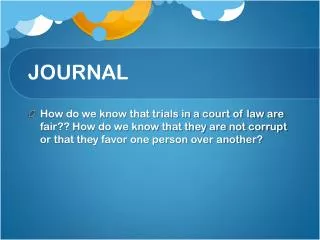
JOURNAL • How do we know that trials in a court of law are fair?? How do we know that they are not corrupt or that they favor one person over another?
5th and 6th Amendments Ensuring Fair Trials
Standards & Objectives • 1.5: Students know the fundamental democratic principles that are a part of our government • Content: Identify protections of the 5th and 6th Amendments • Language: Practice reading comprehension skills by analyzing a Supreme Court decision (in re Gault) • Essential Question: How does the constitution balance individual rights/freedoms with the common good?
What’s your response? • Does what happened to John seem fair? Why? • If you were John, what would you want to happen? • If you think it’s unfair, where does the sense of unfairness come from? Do you know of a rule or law that protects someone like John?
FIFTH AMENDMENT • “No person … shall be compelled, in any criminal case, to be a witness against himself. “ • ….What does this mean, in common language?
I plead the fifth… and the sixth, and seventh, too, if it will help!
SIXTH AMENDMENT • “In all criminal prosecutions, the accused shall enjoy the right to a speedy and public trial, … and to be informed of the nature and cause of the accusation; to be confronted with the witnesses against him; to have compulsory process for obtaining witnesses in his favor, and to have the assistance of counsel for his defense.”
Lets Break It Down • 5th • No self-incrimination: “I plead the fifth!” • 6th • Speedy, public trial • Know what you’re charged with • Know who witnesses against you are, and get your own witnesses • Right to an attorney