Enhancing Ferroelectric Stability at Nanoscale through Interface Engineering
Researchers from Nebraska MRSEC, UW-Madison, and University of Michigan have made significant strides in improving the stability of ferroelectric materials, particularly at the nanoscale. Their work shows that interface engineering, specifically by depositing a non-ferroelectric strontium titanate layer, can enhance the polarization of a barium titanate ferroelectric layer. This innovative approach enables switching of ferroelectric polarization with an applied electric field, opening new avenues for thin-film ferroelectric applications and advancing electronic device technology.

Enhancing Ferroelectric Stability at Nanoscale through Interface Engineering
E N D
Presentation Transcript
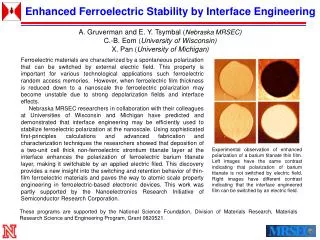
Enhanced Ferroelectric Stability by Interface Engineering A. Gruverman and E. Y. Tsymbal (Nebraska MRSEC) C.-B. Eom (University of Wisconsin) X. Pan (University of Michigan) Ferroelectric materials are characterized by a spontaneous polarization that can be switched by external electric field. This property is important for various technological applications such ferroelectric random access memories. However, when ferroelectric film thickness is reduced down to a nanoscale the ferroelectric polarization may become unstable due to strong depolarization fields and interface effects. Nebraska MRSEC researchers in collaboration with their colleagues at Universities of Wisconsin and Michigan have predicted and demonstrated that interface engineering may be efficiently used to stabilize ferroelectric polarization at the nanoscale. Using sophisticated first-principles calculations and advanced fabrication and characterization techniques the researchers showed that deposition of a two-unit cell thick non-ferroelectric strontium titanate layer at the interface enhances the polarization of ferroelectric barium titanate layer, making it switchable by an applied electric filed. This discovery provides a new insight into the switching and retention behavior of thin-film ferroelectric materials and paves the way to atomic scale property engineering in ferroelectric-based electronic devices. This work was partly supported by the Nanoelectronics Research Initiative of Semiconductor Research Corporation. Experimental observation of enhanced polarization of a barium titanate thin film. Left images have the same contrast indicating that polarization of barium titanate is not switched by electric field. Right images have different contrast indicating that the interface engineered film can be switched by an electric field. These programs are supported by the National Science Foundation, Division of Materials Research, Materials Research Science and Engineering Program, Grant 0820521.


![FERROELECTRIC RAM [FRAM]](https://cdn1.slideserve.com/1817127/ferroelectric-ram-fram-dt.jpg)