Research Methods. APA Ethical Guidelines. Human Drug Trials. The APA – American Psychological Association Responsible for setting the ethical guidelines for human and animal research. The IRB – Institutional Review Board
Une image / un lien ci-dessous est fourni (tel quel) pour télécharger la présentation
Politique de téléchargement : le contenu du site vous est fourni TEL QUEL pour votre information et votre usage personnel ; il ne peut être vendu, concédé sous licence ni partagé sur d’autres sites sans l’accord de son auteur.Le contenu vous est fourni TEL QUEL, pour votre information et votre usage personnel uniquement.Téléchargez la présentation en cliquant sur ce lien.Lors du téléchargement, si vous ne parvenez pas à télécharger une présentation, l’éditeur a peut-être supprimé le fichier de son serveur.Pendant le téléchargement, si vous ne parvenez pas à obtenir une présentation, le fichier a peut-être été supprimé par l’éditeur.
The APA – American Psychological Association • Responsible for setting the ethical guidelines for human and animal research. • The IRB – Institutional Review Board • Part of the APA responsible for reviewing research proposals for ethical violations and/or procedural errors.
Human Research • Research involving human subjects must meet the following standards:
1. Informed Consent • Participants must know that they are involved in research and give their consent.
2. Coercion • Participation in a research study must be voluntary.
3. Anonymity/Confidentiality • The participant’s privacy must be protected. No identities and actions may be revealed. A researched must not share any results that could match a participant and their specific responses. A researcher will not identify the source of any data as well.
4. Risk • Participants cannot be placed at any significant mental or physical risk.
5. Debriefing Procedures • Participants must be told the purpose of the study and provided with ways to contact the researcher about the study results.
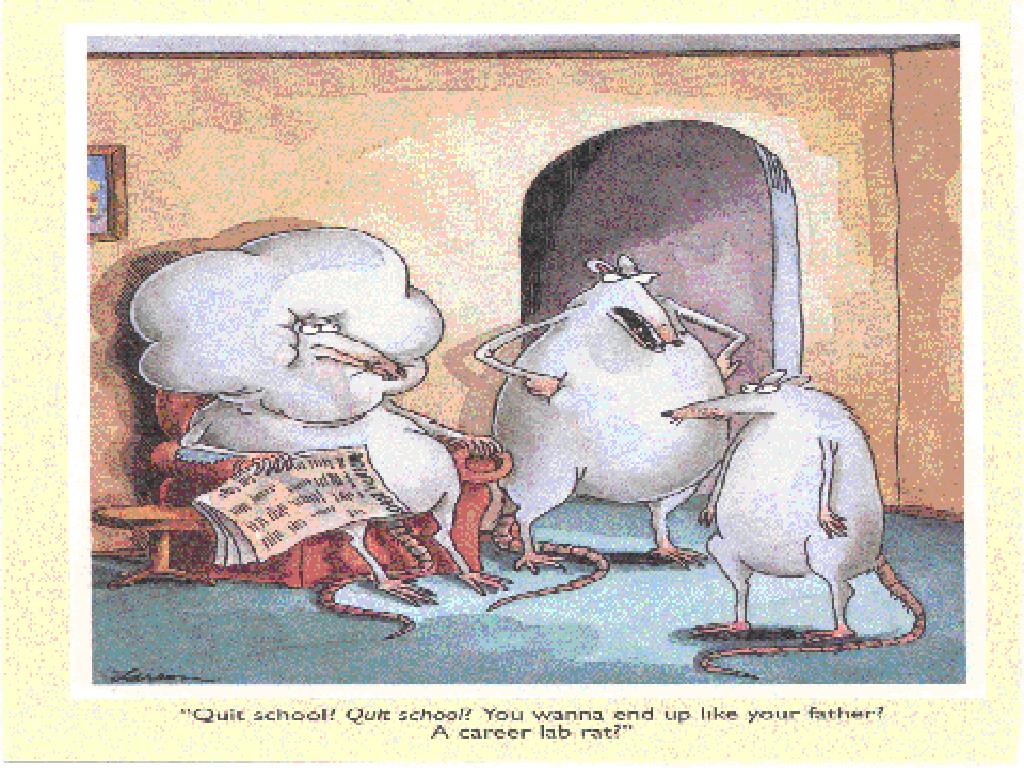
Animal Research • Ethical studies using laboratory animals must meet the following requirements:
1. The must have a clear scientific purpose. • The research must answer a specific, important scientific question. Animals are chosen based on their ability to help answer the question proposed.
Step 1 – Review the existing Literature • Step 2 – Develop a testable Hypotheses • Step 3 – Research and Observation • Step 4 – Analyze the data • Step 5 – Publish, Replicate, Seek Review • Step 6 – Build a Theory
Step 1 • Review the existing literature. What studies have already been completed? What are the current theories and data indicating about behavior?
Step 2 • A hypothesis is then created as a testable prediction based on what is currently known and what we want to find out. What do we want to know more about?
Step 3 • Experiments, surveys, observations, case-studies, etc. are generated to collect data.
Step 4 • The raw data is organized and needs to be evaluated. Statistics may be used to organize, summarize, and interpret the numerical data. Does the data support, or not support, the hypothesis?
Step 5 • The results should be shared with other researchers in a peer-reviewed journal. Other researchers may choose to replicate (repeat) the study to check for validity, or to further explain or explore some aspects of the study.
Step 6 • After one or more studies on a given topic, researchers may advance a theory (current knowledge/concepts that explain a body of data), or challenge a theory.
I. Naturalistic Observation • Researchers study spontaneous and natural behaviors in a subjects most familiar environment. There is no interaction with the subject during these observations.
Researcher Bias • Situation in which a personal factor unfairly increases the likelihood of a researcher reaching a particular conclusion
Example of Bias I was recently mugged by a group of teenagers, or I just had a fight with my teenage son over driving privileges. My assignment is to observe teenage behaviors at the mall. Will I be more inclined to seek out bad behaviors or infer bad intentions and motivations?
Participant Bias • The tendency of research subjects to respond in certain ways because they know they are being observed. The subjects might try to behave in ways they believe the researcher wants them to behave.
II. Case Study • A case study is a situation in which a single individual is studied in-depth by a researcher, often times due to their unique behaviors or situation. Case studies are very interactive and often include face-to-face interviews, paper and pencil tests, the study of medical records, etc.
Police have arrested Bart for the serial killing of fifteen young women over the past ten years. A psychiatrist will examine the police files, medical files, observe and interview Bart, talk to his and the victims families, friends, etc. in order to understand Bart’s behaviors and motivations.
III. Survey • Questionnaires/ interviews. Using a combination of forced and open response questions, it can be helpful in analyzing and predicting behaviors. • Advantageous because you gather a large amount of information from a large group of people.
False Consensus Effect • Tendency to overestimate the extent to which others share our beliefs and behaviors. Skews the reports by jumping to large conclusions that fit into our pre-conceived ideas.
IV. Experiment • An investigation seeking to understand relations of cause and effect. The experimenter changes a variable (cause), and in turn changes another variable (effect). At the same time the experimenter hopes to hold all of the other variables constant so that they can attribute any changes to only the manipulation.
IE. I want to know if new Drug A will help to alleviate the symptoms of insomnia. I can manipulate the dosage and the times, but I need to control other factors like mattress softness, diet and room temperature to eliminate them as variables that affect sleep. At the end of the experiment I want to know that it was only Drug A that affected the patient’s sleep.
Step 1: Choose a Hypothesis • A hypothesis expresses a relationship between two variables. • IE. My hypothesis is that watching violent television programs makes people more aggressive.
Step Two: Choose Variables • Variables are things that are measured, controlled, or manipulated in research.
The dependent variable is measured for change. • IE. Measuring the change in aggression levels is the dependent variable in our experiment because it changes based on what is viewed, for how long, etc.
Step Three: Operationalize • When you operationalize your variables, you are explaining how you will measure them.
Connexion au compte
Connectez-vous pour publier votre contenu sur SlideServe.