

SlideServe
Menu
Préférences
© SlideServe · v2026

Somali Conflicts

oksana avatar
6 diapositives · 332 Views · Aug 08, 2014

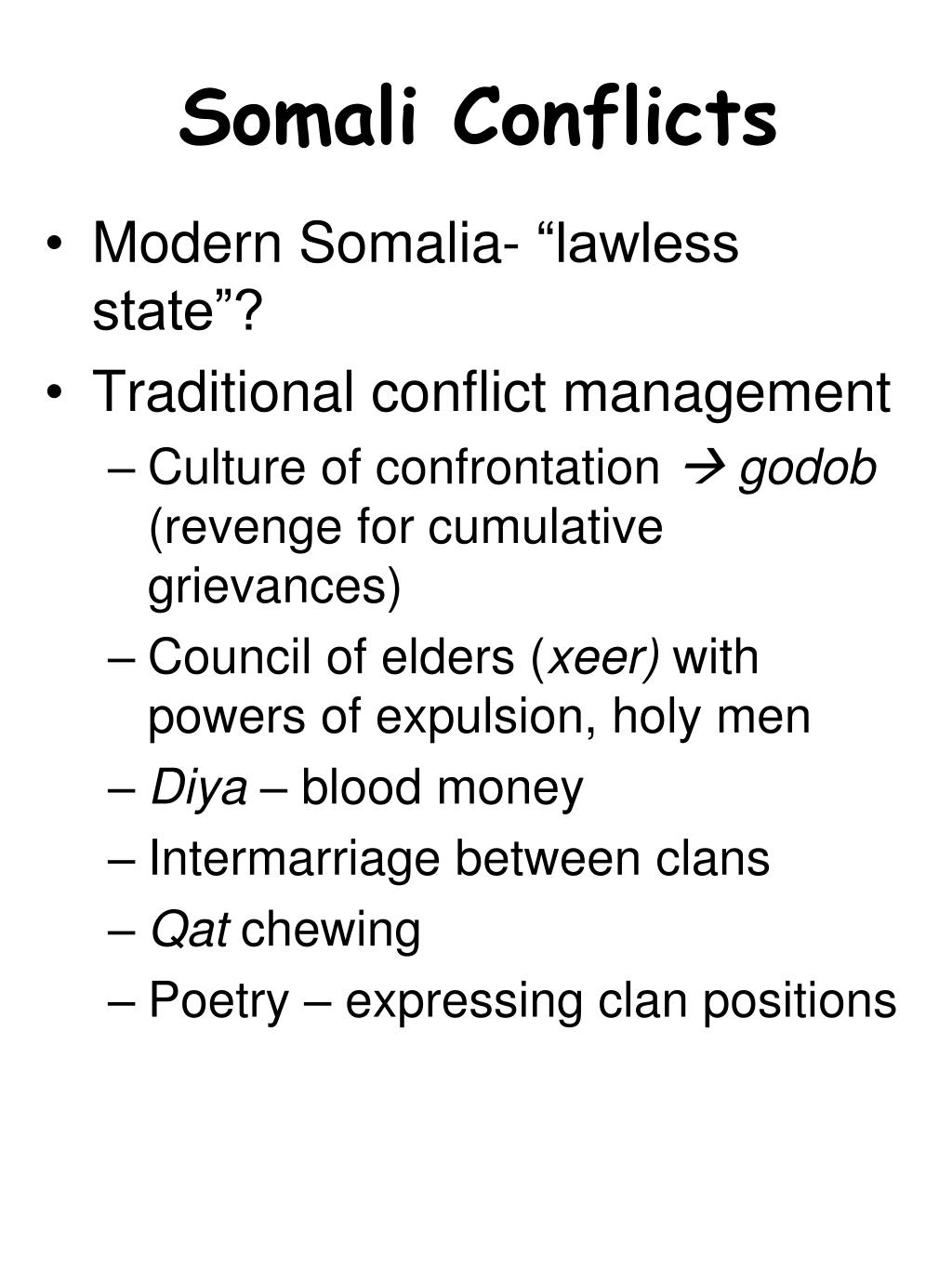
Somali Conflicts. Modern Somalia- “lawless state”? Traditional conflict management Culture of confrontation  godob (revenge for cumulative grievances) Council of elders ( xeer) with powers of expulsion, holy men Diya – blood money Intermarriage between clans Qat chewing
Somali Conflicts - slide 1
01 / 6Somali Conflicts
1 / 17

Télécharger la présentation

Somali Conflicts
Une image / un lien ci-dessous est fourni (tel quel) pour télécharger la présentation

Politique de téléchargement : le contenu du site vous est fourni TEL QUEL pour votre information et votre usage personnel ; il ne peut être vendu, concédé sous licence ni partagé sur d’autres sites sans l’accord de son auteur.Le contenu vous est fourni TEL QUEL, pour votre information et votre usage personnel uniquement. Téléchargez la présentation en cliquant sur ce lien. Lors du téléchargement, si vous ne parvenez pas à télécharger une présentation, l’éditeur a peut-être supprimé le fichier de son serveur.Pendant le téléchargement, si vous ne parvenez pas à obtenir une présentation, le fichier a peut-être été supprimé par l’éditeur.

F I N

Plus de contenu associé

Transcription de la présentation
  1. Somali Conflicts • Modern Somalia- “lawless state”? • Traditional conflict management • Culture of confrontation godob (revenge for cumulative grievances) • Council of elders (xeer) with powers of expulsion, holy men • Diya – blood money • Intermarriage between clans • Qat chewing • Poetry – expressing clan positions

  2. Somali Conflicts 2 • Colonialism: British/Italian • Partitioning of Somali people • Issues of land ownership, productivity  disruption • Colonial military/bureaucratic elite • Imposition of colonial law • Independence = 1960 • Lack of gov’t diversity • Push for “development” – export crops • State-controlled military to replace xeer • Control of national resources

  3. Somali Conflicts 3 • General Siad Barre regime (1969-91) • Personal power, clan exclusion • “modernization” • Cold War politics of arms and aid • 1991 coup • Outside involvement • United Nations • U.S./U.S.S.R • Ethiopia • “New World Order”

  4. New World Order • collapse of USSR end of Cold war  “New World Order” • one size fits all model of state • “rule of law” replaces other authorities • international congregation of states, United Nations to “police” • collective security vs. peacekeeping

  5. Somali Conflicts 4 • 1994-2006: Warlords, Moneylords • 1994: Transitional Federal Government (TFG), led by Abdullah Yusuf • Businessmen support clan militia leaders (NOT traditional elders) • For U.S., issue of terrorism, Somalis involvement in Kenya and Tanzania bombings • Union of Islamist Courts (UIC) • take over Mogadishu, 2005 • establish order, some peace

  6. Somali Conflicts 5 • Dec, 2006: Ethiopia invades, with U.S. backing • growing Islamist insurgency • at present: Drought, displacement, looming famine, ongoing piracy • need for “security, reconciliation, capacity” • power sharing instead of a “victor’s peace”