Understanding Heating Curves and Specific Heat: Key Concepts and Calculations
120 likes | 267 Vues
Dive into the essential concepts of heating curves and specific heat, exploring the differences between temperature changes, state changes, and the significance of sloped and flat lines on heating curves. Learn how to identify melting points and the relationship between kinetic energy and heat transfer. Discover the specific heat calculation for substances and the enthalpy of fusion. Engage with examples like heating ice and cooling water, enhancing your understanding of thermodynamics in practical scenarios.


Understanding Heating Curves and Specific Heat: Key Concepts and Calculations
E N D
Presentation Transcript
Heating Curves and Specific Heat The math begins!
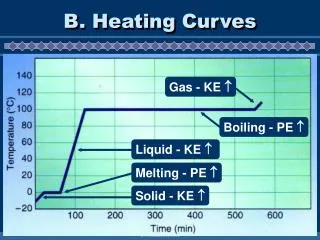
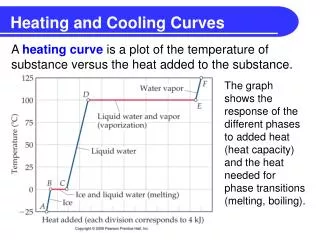
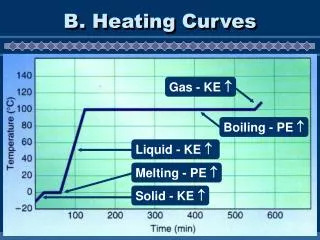
The flat lines on a heating curve represent… • A temperature change. • A constant state of matter. • A change in state. • A slope of 0.
The sloped lines on a heating curve represent… • A constant temperature. • A change in state of matter. • A constant state of matter. • A positive slope.
Which portion of the curve represents the solid melting? • 1 • 2 • 3 • 4 • 5
When does kinetic energy increase on a heating curve? • On the flat portions. • On the sloped lines. • Every point on the curve.
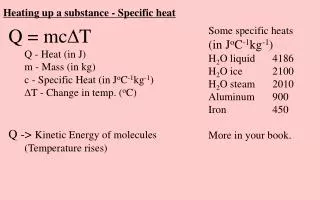
If the specific heat of ice is 0.5 cal/gC°, how much heat would have to be added to 200 g of ice, initially at a temperature of -10°C, to raise the ice to the melting point? • 1000 cal • -1000 cal • 2000 cal • -2000 cal
What is enthalpy of fusion? • Amount of energy to raise temperature of 1g by 10 • Amount of energy needed to boil 1g • Amount of energy needed to melt 1g
Which portion of the curve represents heating of the liquid? • 1 • 2 • 3 • 4 • 5
For the same amount of heat added, a substance with a large specific heat… • Has a smaller increase in temp. • Has a larger increase in temp. • Has the same increase in temp.
What is the specific heat of a metal if 24.8 g absorbs65.7 cal of energy and the temperature rises from20.2 C to 24.5 C? • .62 cal/g C • 78 cal/g C • 66 cal/g C
A hot-water bottle contains 750 g of water at 65 °C. If thewater cools to body temperature (37 °C), how many calories of heat could be transferred to sore muscles? • 23000 cal • 21000 cal • 20000 cal