Scientific method
This guide outlines the essential steps of the scientific method, from making observations and asking questions to forming hypotheses and conducting experiments. A hypothesis is tested through careful experimentation, leading to conclusions that may validate or invalidate the original hypothesis. This process is crucial for scientific inquiry, influencing various fields of study. We also discuss examples of hypotheses related to everyday claims, emphasizing the importance of data collection, analysis, and the differentiation between hypotheses and established theories in science.

Scientific method
E N D
Presentation Transcript
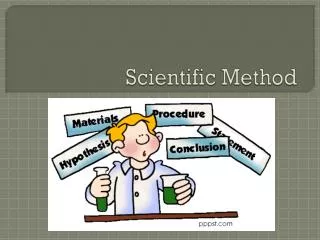
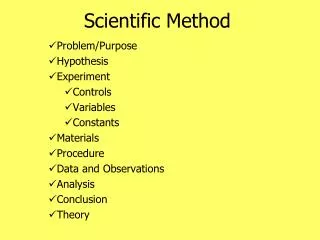
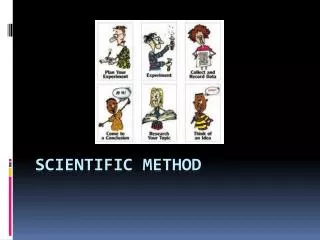
Steps of the Scientific Method • Make an observation • Ask a question • Form a hypothesis • Experiment • Test the Hypothesis • Draw Conclusion • Hypothesis Valid or Invalid • Communicate Results • Data
Hypothesis or Not? • Albert Einstein was the greatest scientist in history.
Hypothesis or Not? • Bacteria will grow more quickly in a warm environment than a cold environment.
Hypothesis or Not? • If a seed is exposed to acids with a pH less than 4, it will not germinate.
Hypothesis or Not? • If a person takes vitamins each day, they will be healthier.
Hypothesis or Not? • If a person lives in the Midwest, they will be friendlier than other people.
Hypothesis or Not? • Growing a plant under a red light bulb will increase the rate at which it grows.
Hypothesis or Not? • Raising the temperature of water will increase the speed in which Kool-Aid dissolves.
Hypothesis or Not? • If a person plays the lottery, they will become rich.
Hypothesis or Not? • Children who don’t watch TV are smarter than children who do watch TV.
Hypothesis or Not? • If a person does cardio exercise three or more times per week, they will have a greater lung capacity than a person who does cardio exercise less than three times per week.
Hypothesis or Not? • German Shepherds are friendlier than Great Danes.
Hypothesis or Not? • A plant that is grown with fertilizer will grow taller than a plant grown without fertilizer.
Hypothesis or Not? • Store brand batteries are able to run a battery-operated device, such as a portable fan, for the same amount of time as national brand batteries.
Hypothesis or Not? • If you use Swifter Max solution, then your floors will look like new.
Hypothesis or Not? • Hoodia is a natural supplement that will help people look fabulous.
Hypothesis or Not? • A plant grown with salt added to its soil will be shorter than a plant grown with no salt added to its soil.
Hypothesis—What is it? • Based on this activity, what is a hypothesis? • Write your response in the journal
Developing a Hypothesis • Observe something • Ask a question • Think of controls and variables • Make it TESTABLE
Is the Hypothesis Correct? • You can tell if your original hypothesis was correct if the outcome is proven by the experiment. • Data Supports your hypothesis • What kinds of data can you collect? • Qualitative • Quantitative • How can you organize it? • Graphs, Charts, and Tables
Data Support Activity • Smart Lesson
Sometimes Data is Odd… The Dread Tomato Addiction • by Mark Clifton • 92.4% of juvenile delinquents have eaten tomatoes. • 87.1% of the adult criminals in penitentiaries throughout the United States have eaten tomatoes. • Informers reliably inform that of all known American communists, 92.3% have eaten tomatoes. • 84% of all people killed in automobile accidents during the year 2006 had eaten tomatoes.
Testing Promotional Claims • Activity
Promotional Claim Example • Product: Red Bull • Promotional Claim: “It Gives You Wiiiings” • Hypothesis: If you drink Red Bull, you will grow wings
Promotional Claim Example • Procedure: • Gather 20 people, and place them into two equal groups. • One group will drink Red Bull, the other will drink water. • Observe both groups for 3 hours after drinking. • Record any sudden growth of wings. • Independent Variable: People drinking Red Bull • Dependent Variable: Wings Growing • Control: Group drinking water
Discussion • What is science? • What is the difference between a hypothesis and theory? • Are any of them unchangeable?
Cell Theory • What is Cell Theory? • Cell Theory: • All living things are made up of one or more cells. All cells arise from existing cells. The cell is the basic unit of structure and function for all organisms. • Evidence: • First formulated in 1839 • Began from the work of three scientists: Schleiden, Schwann and Virchow • Has since been verified by 1,000’s of scientists
Evolutionary Theory • What is the theory of evolution? • Change in the heritable characteristics of a population across successive generations • Evidence: • Work of Charles Darwin (Finches) • Fossil Record • DNA Sequencing • Anatomical Similarities between life forms
What is Gene Theory? • What is Gene Theory? • Traits are passed from parent to offspring via genes. • Evidence: • Work of Gregor Mendel on pea plants and other organisms • 1,000’s of scientists, since Mendel’s time, have conducted experiments that confirm this theory • New DNA technologies continue to confirm this theory and help us learn more about the role of genes in some diseases.
Germ Theory of Disease • What is Germ Theory of Disease? • Microorganisms are the cause of some diseases. • Has led to important things such as antibiotics and good hygiene practices • Evidence: • Resulted from the work of numerous scientists, but is mainly attributed to the work of Louis Pasteur and Robert Koch • Microscopic observations and experimental evidence since late 1800’s continues to confirm this theory.
Hypothesis or Theory • Activity
Hypothesis Versus Theory • In your journal, create a Venn Diagram to distinguish between theories and hypotheses • Include examples of both • Define “science” in your own words
Practice • http://www.ck12.org/concept/Scientific-Investigation/#artifact_title