Download
1 / 18
190 likes | 323 Vues
This comprehensive overview covers the essential characteristics of minerals and the types of rocks—igneous, sedimentary, and metamorphic. You'll learn about the rock cycle, weathering, erosion, and deposition processes. Explore how fossils form and their significance in interpreting past environments. Understand the concepts of relative age, the law of superposition, and methods for determining the relative age of rocks. Additionally, discover the energy transfer involved in geological processes like volcanoes and earthquakes.

E N D
Minerals • Must have the following 5 characteristics: • Naturally occurring • Inorganic • Solid • Crystal structure • Definite chemical composition
Identifying Minerals (physical properties) • Color • Streak • Luster • Density • Hardness • Special Properties
Rock Cycle • Draw
igneous • Extrusive: • Surface • Cooled rapidly • Small crystals • Glassy • Intrusive • Inside earth • Cooled slowly • Larger crystal
sedimentary • Clastic • Rock fragments • Conglomerate & sandstone • Organic • Remains of plants & animals • Coal & limestone • Chemical • Minerals dissolved in solution crystalize • Limestone, halite (rock salt
metamorphic • Foliated • Grains in parallel bands • Gneiss, slate • Nonfoliated • No bands • Grains random
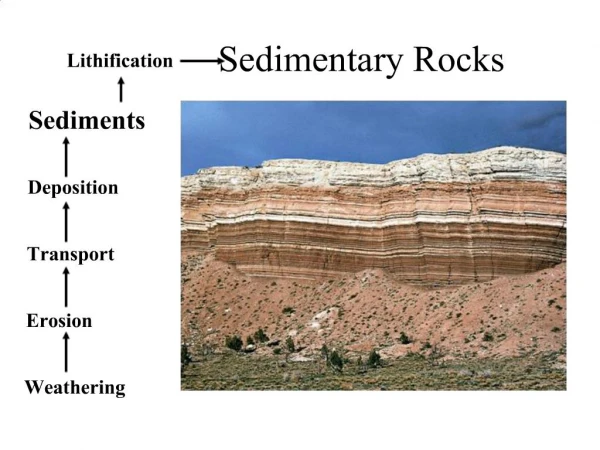
Weathering, erosion, deposition • Weathering • break rock down • Erosion • move it • Deposition • lay down sediment
EROSION • Water • Moves the most sediment • Glaciers • U-shaped valley, till, moraines, kettle lakes • Wind • Sand dunes • Gravity • Move sediment downhill
How fossils form • Death, soft parts decay, hard parts left (teeth, bones) • Sediment covers organism • Sediment becomes rock, preserving parts of organism
Types of fossils • Mold • Cast • Petrified • Cells replaced by minerals or sediment • Bones, petrified wood • Carbon films • Trace fossil • Original/preserved remains • Ice, tar, amber
Fossils & the past • Where do fossils form? • Most: Organisms that once lived in or near shallow water • Sedimentary rock • Tell us about past environments • Shallow bay, ocean bottom, freshwater swamp
Relative Age • Age comparison (older vs. younger) • Law of Superposition • Oldest layers at the bottom, youngest at the top
Determining Relative Age • Extrusion, Intrusion, Fault, Unconformity, Index fossil
Energy transfer • Volcanoes • Heat and mechanical energy as magma flows • Earthquakes • Energy transferred in seismic waves • Mechanical slipping of fault