Download
1 / 49
490 likes | 662 Vues
This resource outlines the fundamental principles of animal nutrition, focusing on the six functions of a good ration and the importance of balancing nutritional needs for livestock. It describes the classification of feeds into roughages and concentrates, the role of feed additives and hormone implants, and best practices for mixing and administering these additives to optimize health and production. Additionally, it emphasizes the significance of understanding maintenance versus production needs and the economic aspects of feed selection.

E N D
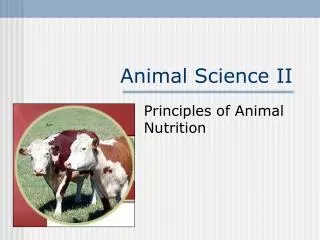
Animal Science II Principles of Animal Nutrition
Objective • Describe the six functions of a good ration
Rations • ________________ of vital body processes to keep animals __________ • _____________ by increasing size • _______________, ________________, _______________, ________________ • ___________________ • Storing _______________ • Not for ______________ or ____________
Rations • Production • _____________ • _____________ • Wool or _________ • ____________________ • ____________ • Other needs must be met _____________ • Most U.S. livestock do no _____________ (horses)
Rations • ______ to ______ of the ration fed to livestock is used for body ______________________ • Maintenance must be met before _____________ are available for other _______________
Objective • Define roughage and concentrates in relation to an animal ration
______ ______ Roughage ______ ______ ______ ______ Roughages • Contains more than 18% crude fiber when that are dry
Concentrates • Contains less than ______ crude fiber when they are _______ • __________-corn, oats, barley, wheat • ____ _____________ • Wheat bran • Cottonseed hulls
Concentrates • Liquid supplements • ______________ • ______________ • Animal _____________ • Meat scraps, fish, and blood __________ • _____________ proteins • Cottonseed __________ • Soybean ___________ • Peanut ____________
Objective • Explain the characteristics of a good ration
Good Rations • Balanced • Has all the _______________ in the right ______________ • _______________ • Taste good • Low Cost • Feed is about _______ of the cost of raising livestock
Good Rations • Not harmful to the health of animals • Too much _____________ _________ can cause ____________________ problems • Uniformly mixed • _______________- vitamins and minerals • Feed ______________
Objective • Define feed additives and hormone implants used in animal rations
Feed Additives and Implants Feed additives • _______________ used in rations • ____________ quantities • Improve ____________________ • Feed efficiency • Rate of gain • Health • Production
Feed Additives and Implants • Hormones Implants • Most are _______________ • _________________ or natural • Improves rate of _____________ and ______________ efficiency
Feed Additives and Implants • Hormones can also be fed as feed _______________
Feed Additives and Implants • Performance stimulants • Increased _____________ by increased _____________________ • Low level antibiotic use is subtherapeutic • Some public concern regarding antibiotic resistance
Feed Additives and Implants • Feed additives are widely used in the beef _________, ________ and ______________ industry • Many different _________________ drugs are used increase performance and prevent disease • Regulated by the _______________________ (______)
Objective • Explain how to properly mix additives in a complete ration
Mixing Additives • The main rule that includes all other rules is “___________________________” • Mixing is required to provide the correct amounts of _________________ • ___________ equipment • Keep accurate records on ____________________ feeds
Objective • Select the appropriate feed additives for the given outcome
Kinds of Feed Additives • Antimicrobial Drugs • ___________________ and antibacterials • Used to control _________________ • Broad-spectrum when the specific disease is unknown • _____________ and ________________ • Hormones • Improve ______________ efficiency • Rate of ___________________ • Mainly used for _______________
Kinds of Feed Additives • Anthelmintics • Used to control ________________ • ________________ and Dichlovos • Others • _____________- coccidiosis in poultry • _____________- prevent bloat in beef cattle • _______________ of MGA to supress estrus in heifers
Objective • Describe the proper method of hormone implantation
Hormone Implantation • _______________ the animal • Use a sharp needle • Prevents ________________ pellets • _____________ the site • Select the proper location • ________ surface • Middle one third of the ______ • ____________ inches from the base
Hormone Implantation • Point the instrument toward the head _______________ to the ear • Insert being careful not to hit a __________ or _______________ • Withdraw ___________, start the implant and remove • Removing too quickly can _________ the pellet
Objective • Discuss the general principles in balancing rations
Balancing Rations • Balanced to meet the animal’s _________ at the least __________ • Variety of fresh feeds • More _______________ • Easier to _______________ • _____________ • Filling • Helps in digestion
Balancing Rations • Slightly _________________ • Improve feed efficiency • Prevent _________________ • Economical • price per pound of energy and digestible protein • Suitable • ________________ for cattle • ________________ for swine and poultry • High ________________ for younger animals
Objective • Interoperate the relationship between 100% dry matter basis and as-fed basis for rations
Feed on 100% dry matter basis Percent dry matter in feed Pounds of feed as-fed X = Dry Matter • All _________________ has been removed
Dry Matter 100g can of dog food As- Fed Dry Matter Protein 40% Protein 10% Protein 10g Other 15% Other 15g Other 60% Water 75g Water 75%
Feed on a dry matter basis Feed on an As-fed basis = Percent dry matter in feed Air Dry • Still has moisture
Dry Matter vs. As-fed • The weight of 100% dry matter is ____________ • No _____________ or moisture is contained • Provides an accurate indication of feed content • Feeds can vary in _______________ content
Dry Matter Content • 100% dry matter basis of sun cured hay is about ____________ of as-fed basis • 100% dry matter basis of most fresh pasture grasses is about ____________ of as fed basis • 100% dry matter basis of most corn (not silage) is about _________ of as-fed basis
Dry Matter Content • Most feed will stabilize to about _________ dry matter in air drying • Storing high moisture feed materials will cause them to ____________ or build up ____________
Objective • Identify the rules for feeding various kinds of livestock
Rules for Feeding Livestock • Beef Cattle (fattening) • __________ to ______lbs. Of air-dried roughage and _____ lbs. of concentrate per _________ lbs. of body weight Example: An 850 pound steer will need approximately: • 12.75 to 17 lbs. of roughage and • 17 lbs. concentrates • Total= 30 to 34 pounds of feed
Rules for Feeding Livestock • Cattle (maintenance) • mainly ________________ • air dried roughage should be ~2% body weight (1.8 dry matter) • Cows nursing calves should be fed 50% more than dry cows Example: A 1,213 pound cow should be fed about 24 pounds (1213 X .02= 24.26)
Rules for Feeding Livestock • Swine • depends on ________ and ________ of the animal • depends on ____________ • Pigs under _____ pounds and __________ sows need more ____________ than market hogs • Poultry • The ration is ________ of body weight
Pearson Square • Objective Determine the nutritional requirement from appropriate tables using the Pearson Square Method
Finding Nutritional Information • Called feeding standards • Metric vs. English • to convert kg to lb • multiply kg by 2.2 • a 40 kg steer will weigh 88 lbs. • ME- __________________ ____________________ intake
12 Pearson Square 1) Draw a square with lines connecting opposite corners and write the percent crude protein needed at the cross
Corn 8.9 12 Soybean Meal 45.8 Pearson Square • Write the feeds to be used and their crude protein content in the left-hand corners • lowest at the top highest at the bottom
Corn 8.9 33.8 parts corn Soybean Meal 45.8 12 3.1 parts soybean meal Pearson Square Corn- 33.8 divided by 36.9 multiplied by 100= 92% corn SBM 3.1 divided by 36.9 multiplied by 100= 8% SBM
45.8- 12= 33.8 Corn 8.9 12 12-8.9= 3.1 Soybean Meal 45.8 Pearson Square • Subtract the smallest number from the larger along the diagonal lines
Corn 8.9 33.8 parts corn Soybean Meal 45.8 12 3.1 parts soybean meal Pearson Square 36.9 total parts