Download
1 / 6
90 likes | 251 Vues
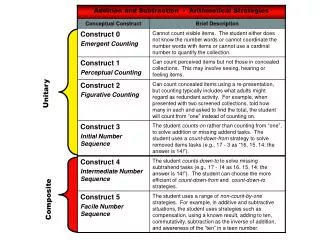
This document outlines a construct-based framework for teaching addition and subtraction strategies, ranging from emergent counting to more advanced number sequence techniques. It details five constructs: 0) Emergent Counting, 1) Perceptual Counting, 2) Figurative Counting, 3) Initial Number Sequence, 4) Intermediate Number Sequence, and 5) Facile Number Sequence. Each construct describes the student's cognitive capabilities in counting and arithmetic, from recognizing visible items to employing complex strategies such as compensation and recognizing inverses. This framework aims to enhance early number understanding.

E N D
Addition and Subtraction - Arithmetical Strategies Conceptual Construct Brief Description Construct 0 Emergent Counting Cannot count visible items. The student either does not know the number words or cannot coordinate the number words with items or cannot use a cardinal number to quantify the collection. Construct 1 Perceptual Counting Can count perceived items but not those in concealed collections. This may involve seeing, hearing or feeling items. Construct 2 Figurative Counting Can count concealed items using a re-presentation, but counting typically includes what adults might regard as redundant activity. For example, when presented with two screened collections, told how many in each and asked to find the total, the student will count from “one” instead of counting on. Unitary Construct 3 Initial Number Sequence The student counts-on rather than counting from “one”, to solve addition or missing addend tasks. The student uses a count-down-from strategy to solve removed items tasks (e.g., 17 - 3 as “16, 15, 14; the answer is 14!”). Construct 4 Intermediate Number Sequence The student counts-down-to to solve missing subtrahend tasks (e.g., 17 - 14 as 16, 15, 14; the answer is 14!”). The student can choose the more efficient of count-down-from and count-down-to strategies. Construct 5 Facile Number Sequence The student uses a range of non-count-by-one strategies. For example, in additive and subtractive situations, the student uses strategies such as compensation, using a known result, adding to ten, commutativity, subtraction as the inverse of addition, and awareness of the “ten” in a teen number. Composite