Inference for Simple Regression
This document explores the basics of simple regression in social research, covering essential concepts such as the regression equation (ŷ = α + βx + ε), slope (β), intercept (α), and how to interpret predicted values. Key measures of predictive error, including Proportional Reduction of Error (PRE) and R², are discussed. It provides practical guidance on using SPSS for regression analysis, including scatterplots, correlation coefficients, and conducting hypothesis tests. The example of infant mortality and female literacy illustrates the application of regression techniques in real-world data analysis.

Inference for Simple Regression
E N D
Presentation Transcript
Inference for Simple Regression Social Research Methods 2109 & 6507 Spring 2006 March 15, 16, 2006
Regression Equation Equation of a regression line: (y_hat) = α +βx y = α +βx + ε y = dependent variable x = independent variable β = slope = predicted change in y with a one unit change in x α= intercept = predicted value of y when x is 0 y_hat = predicted value of dependent variable
補充: Proportional Reduction of Error (PRE)(消減錯誤的比例) • PRE measures compare the errors of predictions under different prediction rules; contrasts a naïve to sophisticated rule • R2 is a PRE measure • Naïve rule = predict y_bar • Sophisticated rule = predict y_hat • R2 measures reduction in predictive error from using regression predictions as contrasted to predicting the mean of y
Example: SPSS Regression Procedures and Output • To get a scatterplot (): 統計圖(G) → 散佈圖(S) →簡單 →定義(選x及y) • To get a correlation coefficient: 分析(A) → 相關(C) → 雙變量 • To perform simple regression 分析(A) → 迴歸方法(R) → 線性(L) (選x及y)(還可選擇儲存預測值及殘差)
SPSS Example: Infant mortality vs. Female Literacy, 1995 UN Data
Example: correlation between infant mortality and female literacy
Regression: infant mortality vs. female literacy, 1995 UN Data
Global test--F檢定: 檢定迴歸方程式有無解釋能力 (β= 0)
The regression model (迴歸模型) • Note: the slope and intercept of the regression line are statistics (i.e., from the sample data). • To do inference, we have to think of α and β as estimates of unknown parameters.
Regression as conditional means • Ways to think about regression: • Straight-line description of association • Prediction • Conditional means (條件平均數) Conditional mean: a mean computed conditional on the value of another variable Regression line predicts the conditional mean of y given x
Assumptions for regression inference Think about there as being a population or “true” regression line Assumptions: • For any fixed value of x, the response (y) varies according to a normal distribution. Repeated responses y are independent of each other. • μy = α +βx (means of y conditional on x fall in a straight line) • The standard deviation of y (call it σ) for each value of x is the same. The value of σ is unknown.
Inference for regression • Population regression line: μy = α +βx estimated from sample: (y_hat) = a + bx b is an unbiased estimator (不偏估計式)of the true slope β, and a is an unbiased estimator of the true intercept α
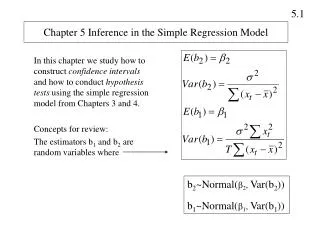
Sampling distribution of a (intercept) and b (slope) • Mean of the sampling distribution of a is α • Mean of the sampling distribution of b is β
Sampling distribution of a (intercept) and b (slope) • Mean of the sampling distribution of a is α • Mean of the sampling distribution of b is β • The standard error of a and b are related to the amount of spread about the regression line (σ) • Normal sampling distributions; with σ estimated use t-distribution for inference
The standard error of the least-squares line • Estimate σ (spread about the regression line using residuals from the regression) • recall that residual = (y –y_hat) • Estimate the population standard deviation about the regression line (σ) using the sample estimates
Standard Error of Slope (b) • The standard error of the slope has a sampling distribution given by: • Small standard errors of b means our estimate of b is a precise estimate of • SEb is directly related to s; inversely related to sample size (n) and Sx
Confidence Interval for regression slope A level C confidence interval for the slope of “true” regression line β is b ± t * SEb Where t* is the upper (1-C)/2 critical value from the t distribution with n-2 degrees of freedom To test the hypothesis H0: β= 0, compute the t statistic: t = b/ SEb In terms of a random variable having the t,n-2 distribution
Significance Tests for the slope Test hypotheses about the slope of β. Usually: H0: β= 0 (no linear relationship between the independent and dependent variable) Alternatives: HA: β> 0 or HA: β< 0 or HA: β ≠ 0
Statistical inference for intercept We could also do statistical inference for the regression intercept, α Possible hypotheses: H0: α = 0 HA: α≠ 0 t-test based on a, very similar to prior t-tests we have done For most substantive applications, interested in slope (β), not usually interested in α
Regression: infant mortality vs. female literacy, 1995 UN Data
Hypothesis test example 大華正在分析教育成就的世代差異,他蒐集到117組父子教育程度的資料。父親的教育程度是自變項,兒子的教育程度是依變項。他的迴歸公式是:y_hat = 0.2915*x +10.25 迴歸斜率的標準誤差(standard error)是: 0.10 • 在α=0.05,大華可得出父親與兒子的教育程度是有關連的嗎? • 對所有父親的教育程度是大學畢業的男孩而言,這些男孩的平均教育程度預測值是多少? • 有一男孩的父親教育程度是大學畢業,預測這男孩將來的教育程度會是多少?