Modeling Stakeholder Preferences through Probabilistic Inversion in Decision Theory
This document presents a comprehensive exploration of stakeholder preference modeling using probabilistic inversion. It delves into the foundations of decision theory, highlighting the significance of expert judgment in uncertainty quantification, particularly in realms such as health risk assessment related to nanotechnology and air pollution. The research emphasizes empirical methods in preference elicitation, advocating for data-driven insights over assumed rationality. The study explores various modeling techniques, including MAUT and AHP, while addressing challenges such as preference convergence and community validation.

Modeling Stakeholder Preferences through Probabilistic Inversion in Decision Theory
E N D
Presentation Transcript
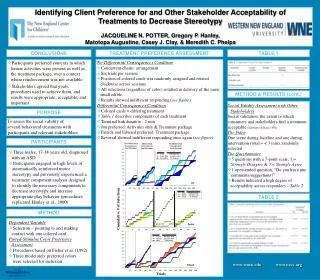
Stakeholder Preference Modeling with Probabilistic Inversion Roger M. Cooke Resources for the Future Dept Math, TU Delft June 16, 2011
Foundations • Health states • Risks nano-enabled food
Expert Judgment for Uncertainty Quantification: PM2.5 Uncertainty in Mortality Response to Airborne Fine Particulate Matter: Combining European Air Pollution Experts Jouni T. Tuomisto, Andrew Wilson, John S. Evans, Marko Tainio (RESS 2008)
Fundamental Theorem of Decision TheoryFor Rational PreferenceUNIQUE probability P which represents degree of belief:DegBel(France wins worldcup) > DegBel(Belgium wins worldcup) P(F) > P(B)AND a Utility function, unique up to 0 and 1, that represents values:($1000 if F, $0 else) > ($1000 if B, $0 else) Exp’d Utility (($1000 if F, $0 else)) > Exp’d Utility (($9000 if B, $0 else)) BUT….
UNLIKE Expert Judgment: There is no • Updating utilities on observations • Convergence of utilities via Observations • Empirical control on Utilities • Community of ‘Utility Experts’ • Rational consensus on Utilities
Validation??? Why is Preference Modeling Impoverished? AHP MAUT MCDM ELECTRA REMBRANT OUTRANKING THURSTONE BRADLEY TERRY PROBIT LOGIT NESTED LOGIT PSYCH’L SCALING
What means Validation? Fools’s Errand Goal = find ‘true Utility values’ for alternatives?
Condorcet’s Paradox of Majority Preference 1/3 prefer Mozart > Hayden > Bach 1/3 prefer Hayden > Bach > Mozart 1/3 prefer Bach > Mozart > Hayden THEN 2/3’s prefer Bach > Mozart Mozart > Hayden Hayden > Bach
What can we do? Random Utility Theory Each (rational) stakeholder has a utility function over alternatives characterize population as distribution over utility functions
Probabilistic Inversion G maps utilities into choices Domain: utility functions Of stakeholders Observe Stakeholders Preferences Range: choices of stakeholders Invert G at this distribution
Used for stakeholder Preference Modeling: • Risks of Nano enabled foods (Flari, WHO, CIS) • Valuing impaired health states (Flari, FDA) • Valuing fossil fuel policy options (RFF) • Prioritizing ecosystem threats (NCEAS) • Prioritizing zoonose threats (RIVM) • Modeling wiring failure (Mazzuchi) • Prioritizing vCVJ options (Aspinall Health Canada) • UK Research Council (Aspinall) • Aus. Univ. FacSci reviews (Aspinall).
steps • Get discrete choice data from stakeholders for choice alternatives A1,…An • “Which of (A,B) do you prefer” • “Rank your top 3 of (A, B, C, D, E, F)” • Find dist’n over utilities on [0,1]n which reproduces stakeholders preferences • If utility is function of covariates, validate out of sample.
Valuation of impaired Health statesFlari et al 17 health states 6 criteria Each criteria has 3 values, described in narrative 19 Experts ranked 5 groups of 5 health states
First, find dist’n over utilities for the 17 Health States which recover Observed Frequencies of rankings (i.e. wo criteria)
Build MAUT model for HS utilities, based on the 6 criteria • Each stakeholder has a weight vector that determines his/her preference • Population of stakeholders = population of weights • Characterize population based on all rankings involving at least 7 (30%) experts (= 28 rankings). • Validate on remaining rankings (= 77 rankings)
Predict out-of-sample rankings First time in HISTORY that a multi attribute model has been WRONG!!!
Average of predictions vs Out-of-Sample observed rankings, Not SOOO bad
Conclusion • Stakeholder preference modeling is empirical science • ‘preference for criteria’ inferred from data, not elicited • (in) dependence in choices inferred from data, not assumed THANK YOU