Exploring Energy Sources: Nuclear, Light, Sound, Electrical & Thermal
Learn where nuclear, light, sound, electrical, and thermal energy come from, how they are transferred, and calculate kinetic and potential energy examples.

Exploring Energy Sources: Nuclear, Light, Sound, Electrical & Thermal
E N D
Presentation Transcript
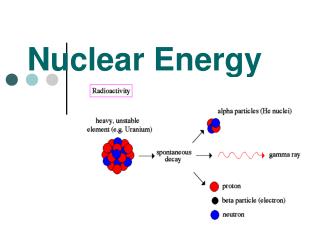
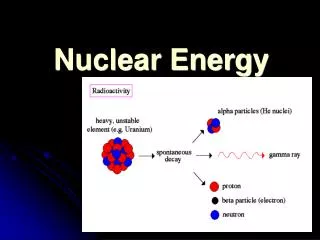
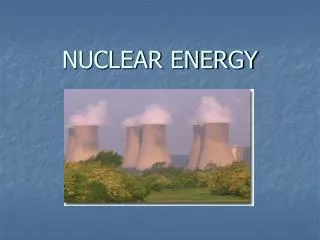
NUCLEAR ENERGY Where does the energy come from? Energy that comes from changes in the nucleus of an atom
How is energy given off from the nucleus? • When two nuclei join, called fusion Ex. hydrogen joining to form helium
How is energy given off from the nucleus? • When the nucleus splits apart, called fission Ex. In nuclear reactors; making nuclear weapons
LIGHT ENERGY • Where does the energy come from? • Energy comes from vibrations in electrically charged particles
Invisible light? • Not all light can be seen • Light does NOT need matter to transfer energy. • Light energy can transfer through space
SOUND • Where does its energy come from? • Energy comes from an object’s vibrations • Ex. Strings on instruments cause the air molecules around them to vibrate. Vibrations carry the sound to our ears • Sound requires matter to transfer energy
ELECTRICAL ENERGY • Energy comes from moving electrons • Energy is transferred from a power plant through wires
CHEMICAL ENERGY • Energy comes from the rearrangement of atoms when new compounds form
THERMAL ENERGY • Depends on the motion of the molecules AND how many molecules are present.
WHAT DOES THAT MEAN? • Higher temperature = more thermal energy • Larger amount of a substance = more thermal energy
THERMAL ENERGY TRANSFER • Heat is the transfer of energy from one substance to another • It transfers from the warmer object to the cooler object • The transfer will end when both objects reach the same temperature
THREE WAYS TO TRANSFER THERMAL ENERGY • Conduction • Convection • Radiation
CONDUCTION • Particles from a warmer object transfer by colliding with particles from the cooler object.
CONDUCTORS AND INSULATORS • Substances that conduct thermal energy very well are conductors Substances that do not conduct thermal energy very well are insulators
CONVECTION • Transfer of thermal energy by the movement of a liquid or a gas
RADIATION • Thermal energy transferred through electromagnetic waves • Visible light, ultraviolet, infrared, x-rays…..
MECHANICAL ENERGY • Mechanical energy = kinetic energy + Potential energy • ME = KE + PE
KINETIC ENERGY • Kinetic energy is energy due to motion • Book example: KE allows the hammer to do work on the nail • KE = mv2 or ½(mv2) 2
CALCULATE: • How would the KE increase if an object doubled its speed? • It would change by 22 or 4 times as much
CALCULATE: • What is the KE of a car that has a mass of 1200 kg and is moving at 20 m/s? • Remember KE = mv2 2
KE = 1200 kg x (20 m/s)2 2 = 1200kg x 400 m2/s2 2 = 480,000 kg x m2/s2 2 = 240,000 Joules
POTENTIAL ENERGY • Energy that an object has due to its position. • Gravitational Potential Energy • Work was done on an object to lift it up against gravity • GPE = m x g x h • GPE = weight x height
CALCULATE: • What is the GPE of a book that weighs 13N and is 1.5 meters off of the ground? • GPE = 13N x 1.5 m • 19.5 N x m • 19.5 Joules