The Thomson Model of the Hydrogen Atom: Exploring Atomic Structure (1897)
In 1897, Joseph John Thomson proposed the Plumb Pudding Model, suggesting the atom is a positively charged sphere with embedded electrons, marking a significant milestone in atomic physics. This model arose from his discovery of the electron, which earned him the Nobel Prize in Physics in 1906. The work laid the groundwork for subsequent atomic models, including Rutherford and Bohr's theories. Additionally, the emission and absorption spectra of hydrogen provide further insights into atomic structure, energy levels, and transitions that define the behavior of the hydrogen atom.

The Thomson Model of the Hydrogen Atom: Exploring Atomic Structure (1897)
E N D
Presentation Transcript
Atomic Physics II Hydrogen Atom Model
Thomson Model Plumb Pudding Model (1897)- Joseph John Thomson proposed that the atom was a sphere of positive electricity (which was diffuse) with negative particles imbedded throughout after discovering the electron, a discovery for which he was awarded the Nobel Prize in physics in 1906.
http://galileo.phys.virginia.edu/classes/109N/more_stuff/Applets/rutherford/rutherford2.htmlhttp://galileo.phys.virginia.edu/classes/109N/more_stuff/Applets/rutherford/rutherford2.html
http://galileo.phys.virginia.edu/classes/252/Rutherford_Scattering/Rutherford_Scattering.htmlhttp://galileo.phys.virginia.edu/classes/252/Rutherford_Scattering/Rutherford_Scattering.html
http://galileo.phys.virginia.edu/classes/109N/more_stuff/Applets/rutherford/rutherford.htmlhttp://galileo.phys.virginia.edu/classes/109N/more_stuff/Applets/rutherford/rutherford.html
Rutherford Scattering experiment http://chemweb.chem.pitt.edu/pictures/vd02_004.htm
Bohr Atom http://galileo.phys.virginia.edu/classes/252/Bohr_Atom/Bohr_Atom.html
Rydberg constant and Atomic spectrum The frequency of the radiant energy is where h is the Plank constant. and
In particular if n1 = 2 n2 = 3, 4, 5, ....... this series is known as Balmer series. Other series : n1 = 1 n2 = 2, 3, 4, ....... Lyman n1 = 2 n2 = 3, 4, 5, ....... Balmer n1 = 3 n2 = 4, 5, 6, ....... Paaschen n1 = 4 n2 = 5, 6, 7, ....... Brackett n1 = 5 n2 = 6, 7, 8, ....... Pfund
Example 4.1 Calculate the limiting value (n2 = ) of Paschen series with n2 > 3 and n1 = 3 and the corresponding energy.
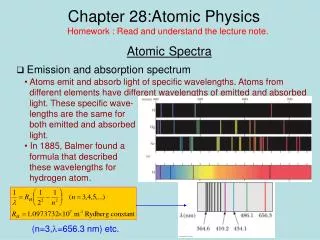
4.31 Emission spectra • Line spectra • - separate bright lines with definite wavelength • - produced by luminous gases at low pressure in the discharge tube • - the atoms are far apart not to interact with each other • - no 2 elements give the same spectrum Band spectra • Spectrum produced by molecules or molecular vapour • - several well defined groups / bands of lines • - closed together • obtained from molecules of glowing gases heated / excited at low • pressure • - arise from the interaction % atoms in each molecules • e.g. blue inner cone of a Bunsen burner flame
Continuous spectra • emitted by hot solid and liquid also by hot gases at high pressure • atoms are so closed that interaction is inevitable • - all wavelengths are emitted • The Absorption Spectra • line, band, continuous spectra are again obtained • when white light passes through a cooler gas or vapour, the atom • absorb the light of the wavelengths which they can emit and then • re- radiate the same wavelengths almost at once but in all directions • - dark lines occur against the continuous spectrum of white light • exactly at those wavelengths which are present in the line • emission • spectrum of the gas or vapour • e.g. absorption spectrum of iodine vapour
Sun’s spectrum & the Fraunhofer dark lines • prescence of a layer of cooler gas round the sun • absorption spectrum http://tycho.bgsu.edu/~laird/phys655/class/IC.html