Calculating Stopping Distance of a Train with Constant Deceleration
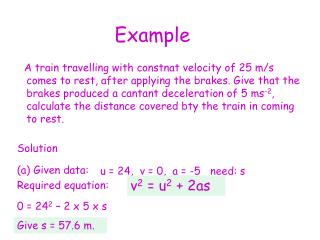
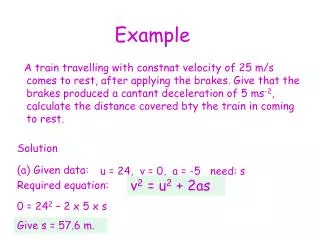
A train traveling at a constant velocity of 25 m/s comes to rest after applying the brakes, which produce a constant deceleration of 5 m/s². To determine the distance covered by the train before it stops, we'll use the kinematic equation that relates initial velocity, final velocity, acceleration, and distance. Given that the initial velocity (u) is 25 m/s, the final velocity (v) is 0 m/s, and the acceleration (a) is -5 m/s², we can solve for the stopping distance (s) using the equation ( v^2 = u^2 + 2as ).

Calculating Stopping Distance of a Train with Constant Deceleration
E N D
Presentation Transcript
Example A train travelling with constnat velocity of 25 m/s comes to rest, after applying the brakes. Give that the brakes produced a cantant deceleration of 5 ms-2, calculate the distance covered bty the train in coming to rest. Solution (a) Given data: u = 24, v = 0, a = -5 need: s v2 = u2 + 2as Required equation: 0 = 242 – 2 x 5 x s Give s = 57.6 m.