Download
1 / 13
130 likes | 263 Vues
The 2006 ARCUS Meeting in Washington focused on the central Arctic Ocean's environmental variability. Key discussions included biostratigraphy from recent drilling at Sites M2A and M4A, featuring age constraints from various microfossils. Highlights included sea ice variability and CryoSat mission goals, emphasizing the need for advanced research infrastructure in polar conditions. The meeting aimed to generate a multinational polar research platform, enhance educational outreach, and promote collaboration among countries for Arctic exploration initiatives.

E N D
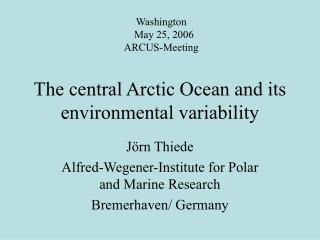
Washington May 25, 2006 ARCUS-Meeting The central Arctic Ocean and its environmental variability Jörn Thiede Alfred-Wegener-Institute for Polar and Marine Research Bremerhaven/ Germany
Biostratigraphy • Composite of Sites • M2A and M4A • - based on dinoflagellates • - additional age constraints: • Middle Eocene • silicoflagellates, diatoms • Early Eocene/Late Paleocene • agglutinated foraminifers • calcareous microfossils and • radiolarians are rare
Sovetskiy Soyuz Oden Vidar Viking Vidar Viking could keep its position for max. 9 days
Submarine Data (Rothrock et al. ,1999) Sea Ice Variability Electromagnetic Thickness Sensor • indications of strong thinning • in central Arctic • global trend not known • CryoSat Mission, Fall 200?
2006: What we can do and what we cannot do • Bad season expeditions • Deep-sea drilling • Deployment of CALYPSO giant piston coring device • Synoptic bipolar expeditions • Deployments of ROV and AUV (or MUV) • Winter navigation based on high-resolution remote sensing information • Provide a novel and safe research platform to the new generation of polar researchers • Regular summer expeditions for all polar research disciplines • Fullfill all logistic requirements (but at the expense of research time) • Provide safety and experienced crews
IPY EPB/ECORD ICARP II The AURORA BOREALIS Challenge • Generate the most modern, innovative and powerful polar research ice-breaker, with an all-season and drilling capabilities • Generate a multinational polar research platform, motivating new countries to invest into their Arctic research programs to meet new challenges • Generate a „floating university“ to educate a new generation of polar researchers • Generate a platform for public outreach and educationals activities • Prepare the road for commercial enterprises in the Arctic Ocean; potential for rescue operations
CryoSat: A Mission to Determine Fluctuations in the Mass of the Earth’s Land and Marine Ice Fields. Prof. Duncan J. Wingham, CryoSat Lead Investigator University College London
Requirements for External Resources Calibration & Validation Scientific Data Processing ~ 250 Gbit/day CryoSat Processor 10 Mbit Data Products
- E O S Monitoring systems for Arctic sea ice and icebergs
Our biggest problems (examples): -To Generate Novel Research Infrastructure -Convince International Partners to join and coordinate- Clean up the maize of Arctic science organisations-Ensure political stability to ensure access to all Arctic regions for all scientific partners To guarantee cutting egde science and safety of science operations in extreme environments