Understanding Algorithms and Efficiency in Computational Problem Solving
120 likes | 227 Vues
This resource outlines foundational concepts in computer science, particularly focusing on algorithms, their definitions, and efficiency measures. Key topics include the definition of algorithms, programming, elementary operations, and various methods to analyze algorithm performance using examples like mathematical induction, Fibonacci numbers, and Euclid's GCD algorithm. The document explains how to compare algorithms based on correctness and resource requirements, offering insights into optimization techniques for improving running time and memory usage.


Understanding Algorithms and Efficiency in Computational Problem Solving
E N D
Presentation Transcript
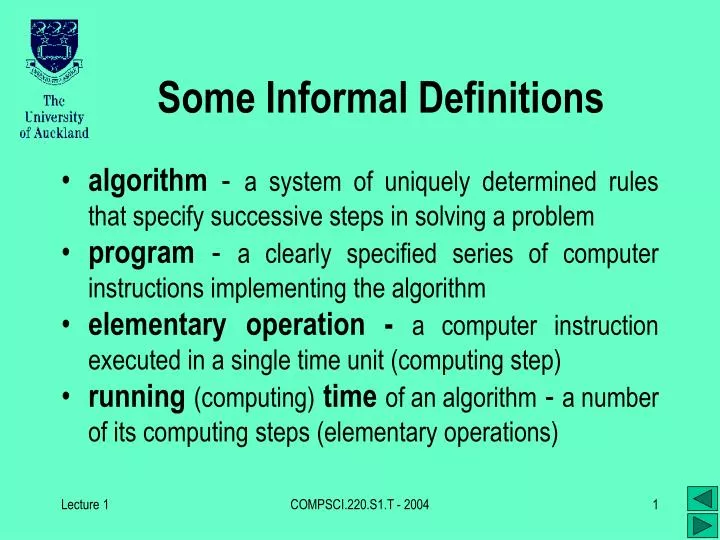
Some Informal Definitions • algorithm - a system of uniquely determined rules that specify successive steps in solving a problem • program - a clearly specified series of computerinstructions implementing the algorithm • elementary operation - a computer instructionexecuted in a single time unit (computing step) • running (computing) timeof an algorithm - a number of its computingsteps (elementary operations) COMPSCI.220.S1.T - 2004
Turing Machine • control device: finite states Q • moving read/write head: • read / write a symbol from / to an infinite tape • move left/right or stay COMPSCI.220.S1.T - 2004
Efficiency of Algorithms How to compare algorithms / programs: • by domain of definition – legal inputs • by correctness – correct output for eachlegal input (in fact, you need a formal proof!) • by basic resources – maximumor averagerequirements:computing timeand memory space COMPSCI.220.S1.T - 2004
Simple Example 1: F(n) = 2n • Implicit formula: F(n) = 2F(n - 1); F(0) = 1, or F(n) = F(n - 1) + F(n - 1); n = 1,2,… • 1, 2, 4, 8, 16, 32, 64, 128, 256, 512, 1024, … • Explicit formula with F(1)= 1: F(n) = 2n • Proof with math induction: • Base condition:F(0) = 20 = 1 • Induction hypothesis:F(n) = 2F(n-1)=2∙2n-1=2n COMPSCI.220.S1.T - 2004
Mathematical Induction Instead of directly proving a relationship T(n), math induction proves the following conditions: • Base condition : T(nbase), e.g., T(0) or T(1) • Inductive hypothesis: for every n>nbase if T(n-1) holds for n-1, then T(n) holds for n; or 2’.Strong induction: if T(k) holds for k=nbase,…,n-1, then T(n) holds for n COMPSCI.220.S1.T - 2004
Example 2: Fibonacci Numbers • 1, 1, 2, 3, 5, 8, 13, 21, 34, 55, 89, 144, 233, … • Implicit formula: F(n) = F(n - 1) + F(n - 2) • Analysis: let’s derive the explicit formula forF(n) • characteristic equation: assumeF(n)=cfn; 1<f < 2 cf n=cf n-1+cf n-2f2=f+1 f1,2= (1±√5) ⁄ 2 • general solution: linear combinationF(n)=c1f1n+c2f2n • F(1)=F(2)=1 COMPSCI.220.S1.T - 2004
Example 2: Euclid’s Algorithm • The greatest common divisor, k =GCD(n,m) is the greatest positive integer such that it divides both two positive integers m and n • “Brute-force” solution: to exhaust all the integers from 1 to the minimum of m and n • Is it practicable to use such algorithm to find GCD(3 787 776 332, 3 555 684 776) or even GCD(9245,7515)? COMPSCI.220.S1.T - 2004
Euclid’s GCD Algorithm • Euclid’s analysis: if k divides both m and n, then it divides their difference (n-m if n>m): GCD(n, m) = GCD(n-m, m) • k divides every difference when the subtraction is repeated up to l times until n- lm<m: GCD(n, m) = GCD( n mod m, m ) where nmodm, or n modulo m is the reminder of the division of n by m (in Java: n%m, e.g. 13%5 = 3) COMPSCI.220.S1.T - 2004
Euclid’s GCD Algorithm GCD(9245,7515) = 5 8 steps vs 7515 steps of the brute-force algorithm! COMPSCI.220.S1.T - 2004
How to Run Faster / Save Memory? • (RF) Save results of computations that could be reused later for the same data • (RF) Tabulate functions of one or two integer arguments with relatively small ranges • (SM) Be careful with recursive computations (tobe sure that the stack is not growing too fast!) • (SM) Free in due time and reuse the allocated memory COMPSCI.220.S1.T - 2004
Linear Space Increase void recursiveFunc(…) { …; recursiveFunc( … ); …; } Stack @parameters registers variables recursiveFunc( … ) @parameters registers variables recursiveFunc( … ) @parameters registers variables recursiveFunc( … ) … … COMPSCI.220.S1.T - 2004
Exponential Space/Time Increase Stack n fibonacci(1)=1 fibonacci(2)=1 fibonacci(3)=2 fibonacci(3)=2 … fibonacci(n) 1.618n5 n – 1 int fibonacci( int n ) { if ( n <= 0 ) return 0; else if ( n == 1 ) return 1; else return fibonacci( n – 1) + fibonacci( n – 2); } Processing time / memory space are proportional tofibonacci(n) n – 2 n – 2 n – 3 n – 3 n – 4 n – 3 n – 4 … COMPSCI.220.S1.T - 2004