Understanding Electric Force: Principles and Applications of Static Charge
This overview explores the concept of electric force as a push or pull between charged objects. We discuss contact and action-at-a-distance forces, highlighting how static charge laws dictate interactions between charged and neutral objects. Key principles include the repulsion of like charges, attraction of opposite charges, and the influence of charge proximity on electric force. Methods of charging objects, such as conduction and induction, are explained with practical examples like an electroscope and the effects of rubbing a balloon against hair. Discover the fundamentals of electric forces!

Understanding Electric Force: Principles and Applications of Static Charge
E N D
Presentation Transcript
OVERVIEW • Force: a push or a pull • Shooting a basketball pushing the ball • Pulling a desk across a room • Contact Forces: forces that have an effect ONLY on the objects that they touch • See above examples
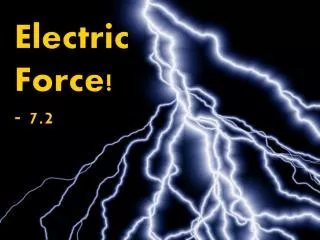
Electric Force: a push or pull between charged objects • Action-at-a-distance Forces: can apply force to an object without touching it • Ex. Electric Force
The Laws of Static Charge • In the past, action-at-a-distance charges were used to see how the 3 types of charges (+, -, neutral) interacted • DISCOVERY! • 2 +ively charged objects would repel each other • 2 –ively charged objects would repel each other • When +ivelyand –ively charged objects were attracted to each other • Charged objects (+/-) were attracted to neutral objects
Laws of Static Charge: • Like charges repel • Opposite charges attract • Neutral objects are attracted to charged objects • Charles Coulomb: electric force is proportional to charge • Increase the amount of charge, increase the amount of electric force • Decrease the amount of charge, decrease the amount of electric force • Increase the distance between charged objects, decrease the electric force • Decrease the distance between charged objects, increase the electric force
Charging by Conduction • The charging of a neutral object by touching it to a charged object • Transferring charge between objects through touching or rubbing • Example: Electroscope • When a negative object touches a neutral electroscope, electrons spread evenly over the metal leaves repel because of negative charge
Charging by Induction • The rearranging of electrons on a neutral object by bringing a charged object close to it • Example: • A negatively charged object will repel electrons in the knob • Because it’s a conductor, the electrons will move down to the leaves which will repel
The Attraction of Neutral Objects • Induction explains why neutral and charged objects attract each other • Balloon becomes negative after being rubbed in hair • Place balloon against the wall • the negative wall charges are repelled, leaving that part of the wall positive (attracting the balloon)
Putting Static Charge to Work • See Figure 7.14 (pg. 261) in Chapter 7 of textbook!