Understanding Biomolecules: Functional Groups, Isomerization, and Reactions
This chapter delves into the essential biomolecules, exploring key functional groups such as hydroxyl, carbonyl, carboxyl, amino, and more. You will learn about molecular asymmetry, chiral and achiral molecules, as well as enantiomers and diastereomers. Dive into significant non-redox reactions including nucleophilic substitution and isomerization, along with condensation and hydrolysis. The content emphasizes the types of mechanisms involved in nucleophilic substitution and provides insights into redox reactions, identifying oxidation and reduction processes.

Understanding Biomolecules: Functional Groups, Isomerization, and Reactions
E N D
Presentation Transcript
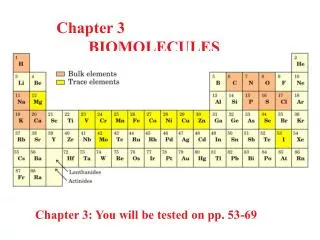
Chapter 3 BIOMOLECULES Chapter 3: You will be tested on pp. 53-69
Hydroxyl (alcohol) Carbonyl (aldehyde) (ketone) Carboxyl Methyl Ethyl Phenyl Amino Amido Guanidino Imidazole Sulfhydryl Disulfide Phosphoryl Ester Thioester Ether Anhydride Mixed anhydride Phosphoanhydride Figure 3-5 Know the names and the structures, including electron pairs!
Molecular asymmetry A. Chiral and achiral molecules B. Enantiomers and diastereomers
Some important types of non-redox reactions Nucleophilic substitution reactions Isomerization reactions Condensation and hydrolysis
Nucleophilic substitution reactions 2 types of mechanisms: dissociative and associative
Nucleophilic substitution can also occur at P in phosphate derivatives
Example of a redox reaction oxidation reduction